

Why Emergency Power Systems Are Essential for Business Continuity
An emergency power system designed around commercial solar-plus-battery storage is now a core business continuity asset for organizations that cannot afford downtime. For companies across Sonoma, Napa, Mendocino, and Lake County, modern commercial solar installation paired with advanced battery energy storage systems (BESS) delivers immediate, clean, and reliable backup power when the grid fails—keeping critical operations running, protecting equipment, and safeguarding staff and customers. As grid interruptions become more frequent due to severe weather, wildfire risk, and planned Public Safety Power Shutoffs (PSPS), solar-integrated emergency power offers an exceptionally resilient, scalable, and cost-effective path forward.
Commercial solar with battery storage does more than keep the lights on: it provides a controllable, on-site energy asset that reduces operating costs during normal conditions and delivers uninterrupted power to critical loads during an outage. The U.S. Department of Energy notes, “Microgrids can keep critical facilities and infrastructure operating during emergencies,” underscoring the value of localized, islandable power architectures for resilience. See the U.S. Department of Energy’s overview of microgrids and resilience for additional context.
In commercial applications, the best-performing emergency power system is purpose-built around three pillars:
- A properly sized commercial solar array that maximizes energy harvest and offsets utility costs under normal operations.
- A right-sized battery energy storage system engineered for the required depth of backup (kWh) and instantaneous power (kW) to support mission-critical loads.
- Intelligent controls and an automatic transfer mechanism that sense grid disturbances, island safely, and dispatch stored energy to dedicated critical circuits with no unsafe back-feed.
This approach eliminates fuel logistics, reduces maintenance, and provides silent, emissions-free power. It also supports sophisticated energy strategies—peak shaving, demand charge management, tariff optimization, and arbitrage—so your system works for you every day, not just during outages. The result is a single, integrated investment that strengthens cash flow while hardening your facility against disruption.
Whether you operate manufacturing, hospitality, healthcare, agriculture, food and beverage, cold storage, retail, or office facilities, commercial solar-plus-storage can be custom to your unique risk tolerance and operational priorities. Right-sizing your system ensures critical loads—such as servers and networking equipment, refrigeration, security systems, emergency lighting, HVAC for occupied spaces, and accessibility equipment—continue uninterrupted.
As a regional leader in turnkey commercial solar and battery storage, Pure Power Solutions has spent decades designing code-compliant, high-reliability systems that align with the National Electrical Code (NEC) and NFPA requirements. We deliver integrated solutions that meet the letter of the law for emergency, legally required standby, and optional standby use cases—without compromising your long-term energy strategy or sustainability goals. Explore our commercial storage capabilities here: https://purepowersolutions.com/battery-storage-systems/ and https://purepowersolutions.com/energy-storage-solutions/.
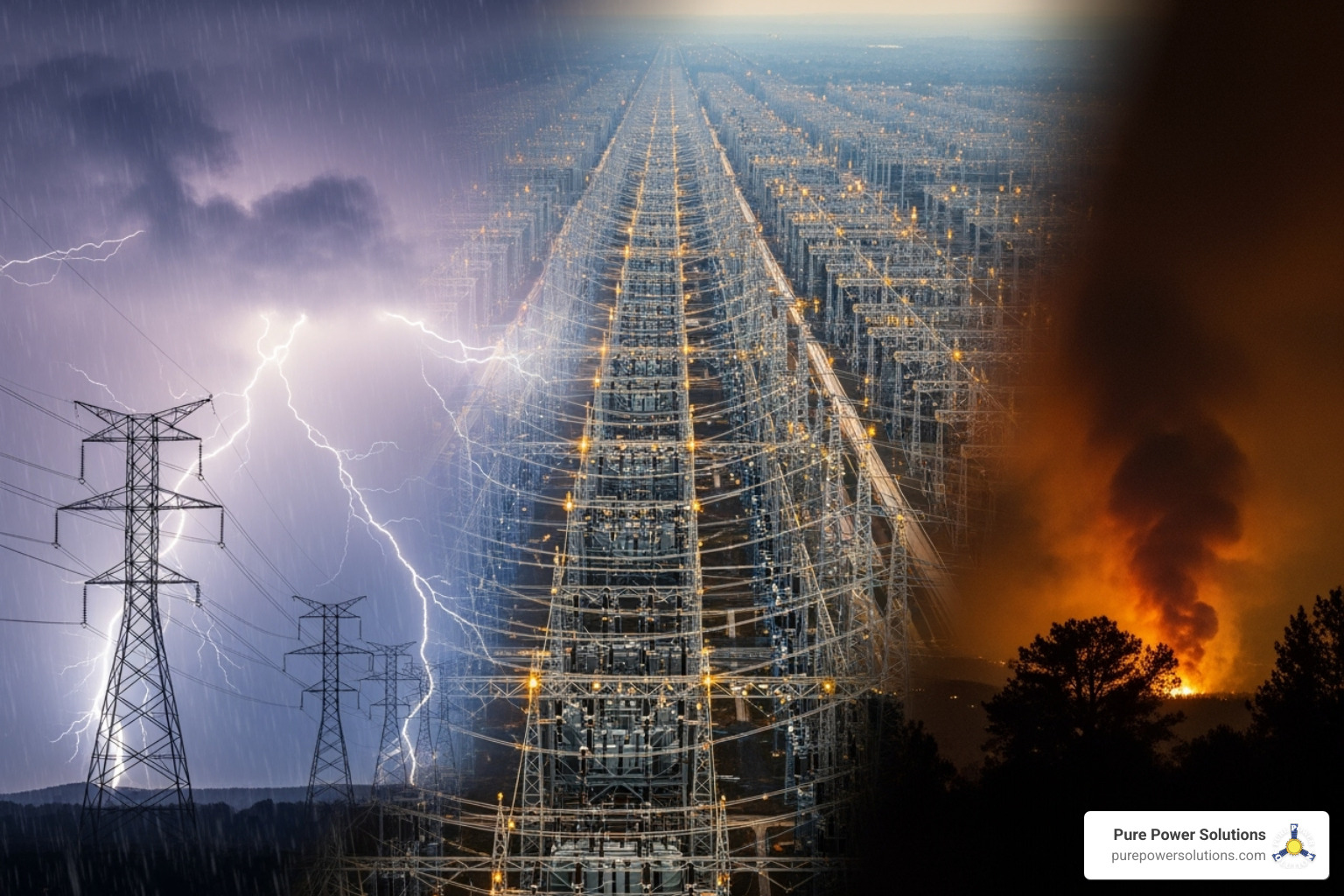
The Critical Divide: Emergency vs. Standby Power
When you’re planning a solar-integrated backup architecture for a commercial facility, it’s essential to understand how codes differentiate between an emergency power system and standby power. These designations directly affect the design, installation, component selection, cost, and inspection/acceptance process. Commercial solar installation teams must design to the correct category and ensure the energy storage and controls meet performance and safety obligations.
What Defines an Emergency Power System?
An emergency power system is mandated for life safety functions and must restore power within 10 seconds of loss of normal supply, as governed by NFPA 70 (NEC) Article 700. In a solar-plus-storage configuration, this typically means:
- Dedicated, independent distribution for emergency circuits (egress illumination, fire alarm power supplies, and other life safety loads where applicable).
- An automatic transfer mechanism and controls that isolate from the utility and energize designated emergency panels safely and rapidly.
- Battery capacity and inverter power sized to meet required runtime (as informed by NFPA 110 EPSS classifications) and instantaneous load demands without delay.
If certain loads cannot tolerate even a momentary interruption, an uninterruptible power supply (UPS) can be integrated upstream of those specific devices to ensure seamless, millisecond-level continuity while the BESS transitions to islanded operation and assumes the full load.
Understanding Legally Required and Optional Standby Power
Standby systems are divided into two categories under the NEC:
- Legally Required Standby Systems (NEC Article 701): These systems must restore power within 60 seconds and support functions that are important for safety but not classified as life safety. Examples can include smoke control fans, pressurization systems, and certain communication or pumping systems. A solar-plus-storage system can serve this role with its own standby distribution, transfer controls, and appropriately sized battery/inverter.
- Optional Standby Systems (NEC Article 702): Installed at the owner’s discretion to protect property, inventory, and business continuity. Typical commercial examples include refrigeration, IT and communications infrastructure, process controls, and essential lighting/HVAC for continued operations. Response time is flexible, and the design is driven by business risk, cost of downtime, and desired runtime.
Comparing System Types for Solar-Plus-Storage
-
Primary Purpose
- Emergency Power (Article 700): Life safety.
- Legally Required Standby (Article 701): Hazard mitigation and rescue support.
- Optional Standby (Article 702): Business continuity and protection of assets.
-
Maximum Transfer Time
- Emergency: 10 seconds.
- Legally Required Standby: 60 seconds.
- Optional Standby: Owner-driven and use-case dependent.
-
Electrical Independence
- Emergency: Dedicated conduits, panels, and wiring independent from normal distribution.
- Standby (Legally Required or Optional): May share certain infrastructure elements where permitted by code, but designs commonly employ dedicated critical load panels for clarity and reliability.
-
Design Implications for Solar-Plus-Storage
- Battery energy storage must be sized by both kW (instantaneous power) and kWh (duration) to meet mandated runtime and load priority.
- Controls and transfer logic must prevent back-feed into the utility and comply with interconnection requirements.
- Testing, maintenance, and documentation must align with the applicable codes and standards (e.g., NFPA 110 for EPSS).
Building the right architecture starts with a careful designation of which loads belong in which category, and then engineering the PV, storage, inverter plant, transfer equipment, and distribution to match those obligations. Our team designs and installs commercial solar-plus-storage systems that are code-aligned for every scenario, from Article 700 emergency circuits to optional standby continuity strategies. Learn more: https://purepowersolutions.com/energy-storage-solutions/.
Anatomy of a Modern Emergency Power System
A modern commercial emergency power system built on solar-plus-battery storage is an integrated microgrid that senses grid conditions, islands safely, and delivers clean, instantaneous power to priority loads. The components must operate as a coordinated whole—maximizing energy harvest and savings during normal operations and providing dependable backup when the grid goes down.
Key Components of a Solar-Plus-Storage EPSS
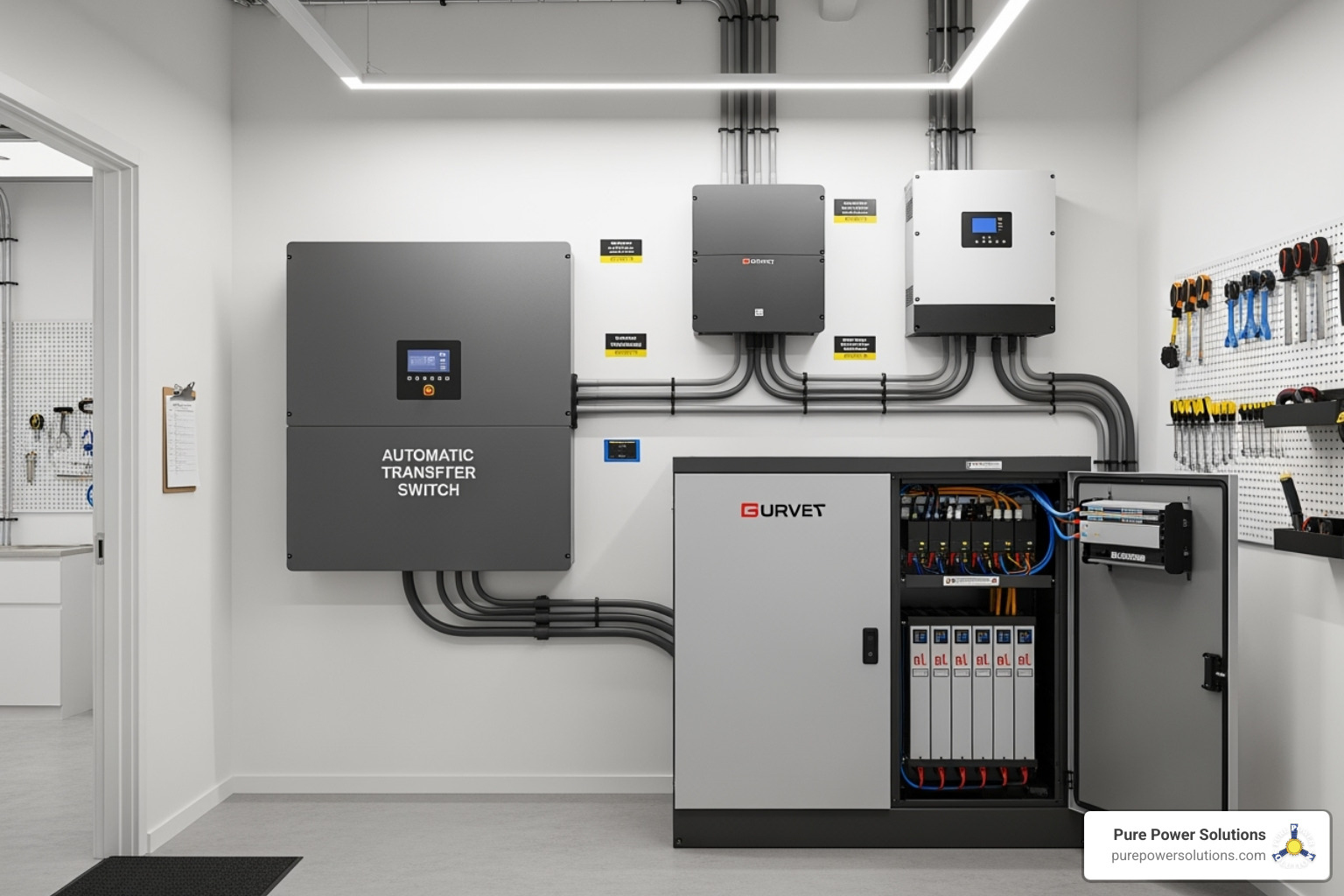
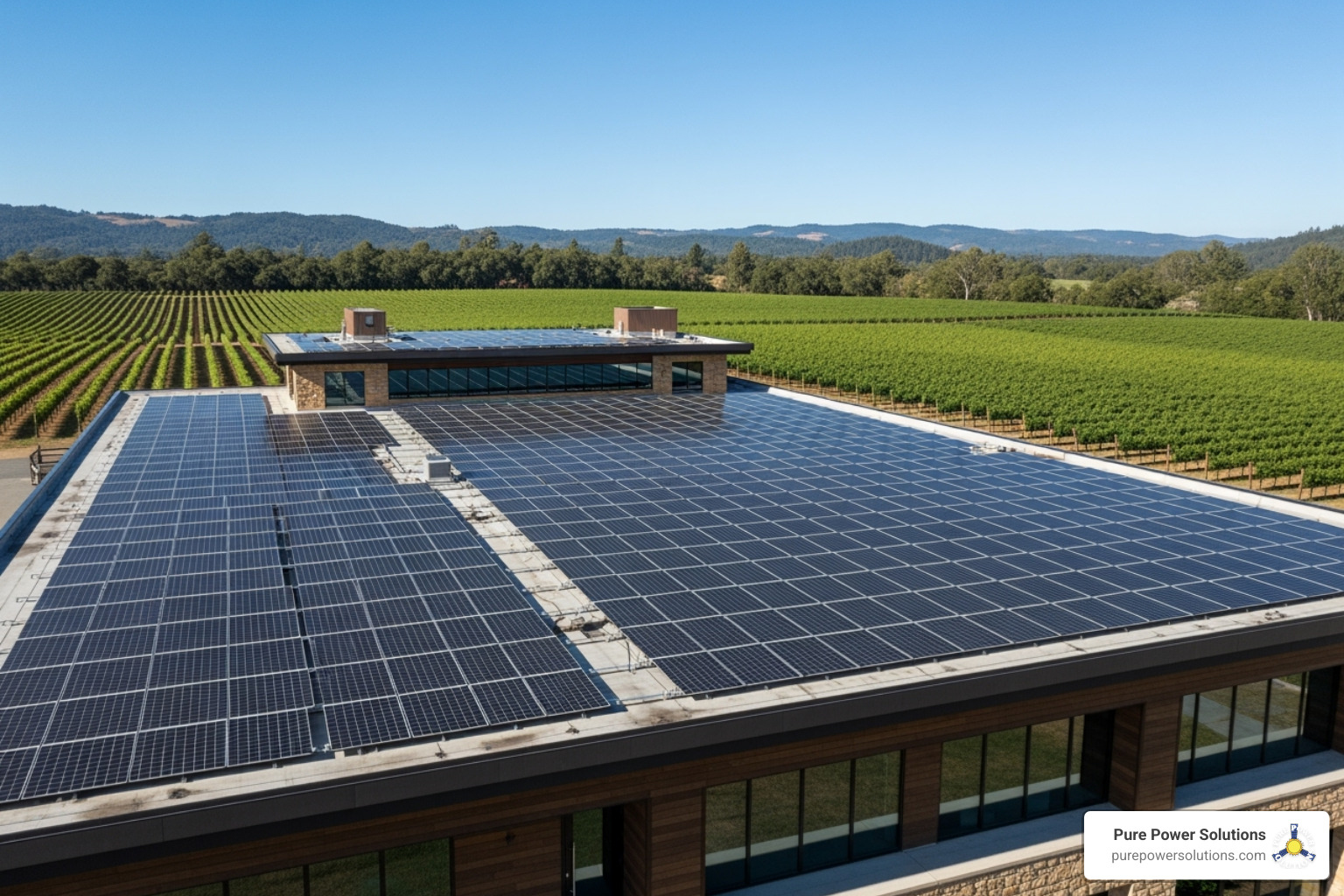
- Commercial PV Array: High-efficiency, large-format modules installed on rooftops, parking canopies, or adjacent land to generate on-site electricity, reducing utility consumption and powering loads and storage.
- Battery Energy Storage System (BESS): Safely stores energy from the PV array or grid for rapid discharge during outages. Lithium-ion chemistries dominate commercial deployments due to high round-trip efficiency, fast response, and compact footprint. BESS is specified by power (kW) and energy capacity (kWh), both of which must align with your critical load profile and desired backup duration.
- Bidirectional Inverters and PCS: Convert DC energy from PV and batteries to AC for facility use, while enabling charging and system controls. Commercial-grade inverters support seamless islanding, grid-forming capability, and compatibility with UL and IEEE interconnection standards.
- Automatic Transfer Switch (ATS) or Transfer Controls: Monitors the normal utility source and, when loss is detected, signals the storage system to form the microgrid while isolating critical circuits, preventing back-feed and ensuring worker safety. In some designs, transfer functionality is integrated into the microgrid controller and switchgear.
- Critical Load Panels and Distribution: Dedicated panels that feed life safety, legally required standby, or optional standby circuits. For Article 700 emergency systems, distribution and wiring are kept independent from normal supply to ensure resilience and compliance.
- Microgrid and Energy Management Controls: Orchestrate dispatch, prioritize loads, maintain power quality, perform self-diagnostics, and run scheduled tests. These controls also optimize daily energy value—peak shaving, demand charge management, and time-of-use shifting—to improve facility economics.
- UPS for Sensitive Loads (as needed): For equipment that demands continuous power without even a sub-second disturbance (e.g., certain servers, network cores, or lab analyzers), a UPS bridges the milliseconds before the islanded microgrid is fully stabilized.
How the System Operates—From Everyday Optimization to Outage Response
- Normal Conditions: PV serves on-site loads first, with surplus used to charge batteries or exported when allowed and advantageous. Controls manage tariff strategies (e.g., reducing demand peaks) to lower bills. The BESS remains in a ready state, tracking state of charge (SoC) to ensure sufficient reserve for contingencies.
- Grid Disturbance: Controls detect voltage/frequency anomalies or total loss of utility. The system isolates from the grid via the transfer mechanism and immediately forms a stable microgrid. Priority loads are energized using battery power, with PV assisting when irradiance is available.
- Extended Outage: PV continues to recharge the BESS during daylight, extending runtime for critical operations and, in many cases, enabling multi-day continuity during PSPS events. Load shedding strategies can be enacted to prolong backup for the most essential systems.
- Reconnection: When utility power returns and is within acceptable parameters, the system resynchronizes and transfers loads back to normal supply in a controlled manner.
Why This Architecture Outperforms Traditional Approaches
- Instant Response and Silence: Batteries deliver power immediately and operate quietly—ideal for occupied commercial environments.
- Lower Operating Costs: No fuel logistics, minimal maintenance, and multi-use value streams (bill savings + backup power) improve total cost of ownership.
- Clean, Sustainable Power: On-site solar with storage reduces emissions and aligns with corporate ESG goals.
- Scalability: Capacity can be increased to support new processes, equipment, or sites.
For a deeper dive into how commercial batteries work and how they integrate into an emergency power system, see: https://purepowersolutions.com/how-does-a-battery-energy-storage-system-work/ and https://purepowersolutions.com/battery-storage-systems/.
Navigating Regulations and Ensuring Compliance
Designing and installing a commercial solar-plus-storage emergency power system requires rigorous adherence to national codes and local authority requirements. The objective is twofold: deliver reliable, safe power to protected loads and ensure the entire installation meets inspection and operational standards throughout its lifecycle.
NFPA 110 and EPSS Classification
NFPA 110 is the foundational standard for Emergency Power Supply Systems (EPSS). It classifies EPSS by runtime (Class), transfer performance (Type), and criticality (Level). In practice:
- Class: Minimum required runtime at rated load (e.g., Class 2 for 2 hours, Class 48 for 48 hours). This informs battery energy capacity (kWh) and solar contribution strategies.
- Type: Maximum permitted transfer time (e.g., Type 10 for 10 seconds aligns with Article 700 emergency systems; Type 60 for 60 seconds aligns with Article 701).
- Level: Level 1 for systems where failure could result in serious injury or loss of life; Level 2 for less critical but still important functions.
NFPA emphasizes the importance of ongoing care: “Maintaining your emergency power supply system is critical, particularly during hurricane season.” Source: NFPA (https://www.nfpa.org/news-blogs-and-articles/blogs/2020/09/18/maintaining-your-emergency-power-supply-system-is-critical-particularly-during-hurricane-season). While our region faces wildfire and PSPS threats more than hurricanes, the principle is universal: disciplined inspection, testing, and maintenance (ITM) under qualified supervision keeps systems dependable.
NEC Articles 700, 701, 702—Getting the Category Right
- Article 700 (Emergency Systems): Life safety loads with strict independence and a maximum 10-second transfer requirement. Designs typically include dedicated emergency panels, wiring methods, and appropriately rated transfer equipment.
- Article 701 (Legally Required Standby): Important safety-related functions that must be restored within 60 seconds.
- Article 702 (Optional Standby): Owner-defined systems for business continuity; flexibility in response time and design. Still requires safe isolation, transfer, and coordination.
Additional Standards and Best Practices for Commercial Solar and Storage
- UL 9540/9540A: Safety of energy storage systems and associated thermal propagation testing methodologies. These inform siting, spacing, ventilation, and fire safety.
- UL 1741 and IEEE 1547: Interconnection, safety, and performance standards for inverters and distributed energy resources.
- California Building and Fire Codes; local Authority Having Jurisdiction (AHJ) requirements: Enclosure ratings, signage, access, ventilation/clearances, and emergency responder interface considerations.
Safety and Installation Best Practices
- Preventing Back-Feed: Transfer equipment must provide a reliable electrical separation from the utility to protect line workers and the public.
- Professional Installation: Commercial EPSS is not a DIY undertaking. Systems must be engineered and installed by qualified professionals versed in PV, storage, switchgear, and code compliance.
- Redundancy Where Appropriate: For high-criticality facilities, additional layers—redundant inverters, parallel battery strings with selective coordination, or N+1 architectures—reduce single points of failure.
- Ventilation and Thermal Management: Battery rooms/enclosures require appropriate thermal management to maintain performance and longevity.
- ITM Program: Regular inspections and scheduled tests validate performance, confirm transfer behavior, and ensure batteries meet expected capacity. Documentation is essential for ongoing compliance.
For broader context on emergency power and microgrids in resilience planning, the U.S. Department of Energy underscores: “Microgrids can keep critical facilities and infrastructure operating during emergencies.” See: https://www.energy.gov/oe. This aligns with how commercial solar-plus-storage is being deployed across critical infrastructure, manufacturing, and services to reduce risk and improve uptime.
Designing the Right System for Your Commercial Needs
Every commercial facility is unique. To build an emergency power system around solar-plus-storage that truly supports your operations—and passes code review—you need a structured engineering process that begins with load analysis and ends with a validated commissioning and ITM plan.
Assessing Facility Loads and Backup Priorities
Start with a comprehensive load study that captures steady-state demand (kW), energy consumption (kWh), and motor-driven surge or inrush currents. Identify and categorize loads as Article 700 emergency, Article 701 legally required standby, or Article 702 optional standby:
- Common Critical Loads: Data centers/IDF rooms; security and access control; refrigeration and cold storage; process controls; emergency lighting and signage; elevators/lifts needed for accessibility and evacuation; ventilation and HVAC for occupied areas.
- Startup Dynamics: Motors, compressors, and pumps can draw 3–7x running current on startup. Ensure inverter capacity, short-term overload capability, and battery power are adequate to ride through.
- Runtime Objectives: Define expected outage profiles (minutes, hours, days) and align battery capacity with your continuity goals. In PSPS-prone areas, daytime PV charging substantially extends runtime; load shedding strategies can further prioritize essential operations.
Right-Sizing PV, BESS, and Controls
- PV Capacity: Sized to reduce your utility spend under normal operations and to support daytime recharging during outages.
- BESS Sizing: Determine power (kW) to cover simultaneous critical loads and energy (kWh) to meet runtime goals (or required NFPA 110 Class where applicable). Consider the reserve margin to maintain performance in shoulder seasons or cloudy conditions.
- Inverter Selection: Choose inverters with certified grid-forming and islanding capabilities, UL/IEEE compliance, and the ability to support planned surge currents and motor starts.
- Transfer and Switchgear: Specify ATS or integrated transfer controls that meet the applicable NEC category and coordinate with facility distribution and protective devices.
- Microgrid Controller: Implement load prioritization, SOC management, peak shaving, TOU arbitrage, and automated test routines.
The Financial Case for Commercial Solar-Plus-Storage
Outages are expensive—lost production, spoiled goods, disrupted service, and potential safety risks. Solar-plus-storage mitigates those losses while driving everyday savings. Demand charge reduction, peak shaving, and time-of-use management can materially lower utility bills. In addition:
Commercial solar projects will be eligible for the 30% tax credit provided the solar energy system must be new and utilize established commercial technology. The business claiming the credit must own the system. Projects must begin construction by July 4, 2026, or be in service by December 31, 2027, for the full credit. There are also conditions regarding percentage of content via FEOC (Foreign Entity of Concern), pace of construction, and utilization of prevailing wage labor.
When you amortize the avoided outage costs and the bill savings over the system’s life, the payback period frequently compares favorably to traditional backup-only approaches. And because solar-plus-storage is fuel-free and low-maintenance, ongoing operating costs are predictable and modest.
Why Solar-Plus-Storage is the Future for Commercial Backup
- Reliability: Few moving parts, instant response, and automated testing routines improve availability.
- Safety and Compliance: Mature standards and proven components support code-compliant emergency, legally required standby, and optional standby use cases.
- Sustainability: Emissions-free operation and alignment with corporate ESG goals.
- Regional Fit: For Sonoma, Napa, Mendocino, and Lake County businesses subject to PSPS events, solar charging extends battery runtime for multi-day resilience.
Pure Power Solutions designs and installs turnkey commercial solar and storage systems that align with your risk profile and compliance needs. Explore our capabilities:
- Commercial Solar Battery Installation: https://purepowersolutions.com/commercial-solar-battery-installation/
- Commercial Solar Battery Storage: https://purepowersolutions.com/commercial-solar-battery-storage/
- Battery Storage Systems: https://purepowersolutions.com/battery-storage-systems/
- Energy Storage Solutions: https://purepowersolutions.com/energy-storage-solutions/
Implementation Roadmap
- Site Assessment and Feasibility: Evaluate structures, available area, interconnection, and code constraints for PV/BESS.
- Load Prioritization Workshop: Define life safety, legally required standby, and business-critical loads and their required runtimes.
- Preliminary Sizing and Modeling: Simulate PV production, tariff optimization, BESS cycling, and outage scenarios to validate economics and resilience.
- Detailed Engineering: Electrical one-lines, protection and coordination studies, ATS/switchgear specification, controls architecture, and code compliance documentation.
- Permitting and Interconnection: Coordinate with AHJs and the utility for timely approvals.
- Construction, Commissioning, and Training: Install to spec, validate transfer/controls, run acceptance tests, and train facility staff.
- ITM Program: Establish an inspection, testing, and maintenance plan in line with NFPA 110 and manufacturer recommendations.
For insight into storage operation and integration steps, see: https://purepowersolutions.com/how-does-a-battery-energy-storage-system-work/.
Conclusion: Secure Your Operations with a Modern Power Solution
For commercial facilities in Sonoma, Napa, Mendocino, and Lake County, the path to reliable emergency power is a solar-plus-storage system engineered to code and tuned to your operational priorities. It delivers rapid, silent, emissions-free power to critical loads, cuts energy costs year-round, and strengthens resilience during PSPS events and grid disturbances.
Pure Power Solutions has over 30 years of experience delivering turnkey commercial solar and battery systems that meet stringent emergency, legally required standby, and optional standby requirements. We partner with your team from assessment through maintenance to ensure your system performs when it matters most.
Contact Pure Power Solutions today for a free consultation. Visit our website at https://purepowersolutions.com or call us at 707-433-6556


