

Why Comparing Commercial Solar Quotes is Critical for Your Business Investment
When you compare solar panel quotes for your business, you’re evaluating a major capital investment that will impact your bottom line for 25+ years. A thorough comparison involves more than just the final price; it requires a deep dive into system size, production estimates, equipment quality, cost breakdowns, and installer credentials. This isn’t just a purchase; it’s a strategic decision that affects your operational costs, energy resilience, and even your brand identity.
Research shows that comparing multiple commercial solar quotes can save businesses significantly on upfront costs. However, the real value comes from understanding the differences in system design, equipment specifications, and financing structures. This ensures you’re making an informed decision that prioritizes long-term performance and return on investment, rather than simply choosing the lowest bidder. A poorly chosen system can lead to years of underperformance, unexpected maintenance costs, and a payback period that never materializes. In contrast, a well-designed system becomes a reliable asset, generating predictable savings and enhancing your company’s commitment to sustainability and Environmental, Social, and Governance (ESG) goals.
As Rody Jonas, owner of Pure Power Solutions since 1993, I’ve helped businesses across Sonoma, Marin, Napa, Lake, and Mendocino Counties select systems that deliver reliable, long-term performance. My experience has shown that the cheapest quote rarely represents the best value when you factor in equipment quality, production guarantees, and installer reputation. A slightly higher upfront cost for premium equipment and a meticulous installer often yields a far greater return through higher energy production, lower degradation, and minimal downtime over the life of the system. Let’s break down exactly what you need to look for in each proposal to ensure your solar investment is a resounding success.
Compare solar panel quotes definitions:
Deconstructing the Commercial Solar Quote: What to Look For
When a solar quote lands on your desk, it can feel overwhelming. But once you understand the essential building blocks of a comprehensive proposal, comparing solar panel quotes becomes much more straightforward. Every legitimate commercial solar quote should give you a complete picture of what you’re getting, how much it costs, and what performance to expect. It should be a transparent document, not a sales brochure.
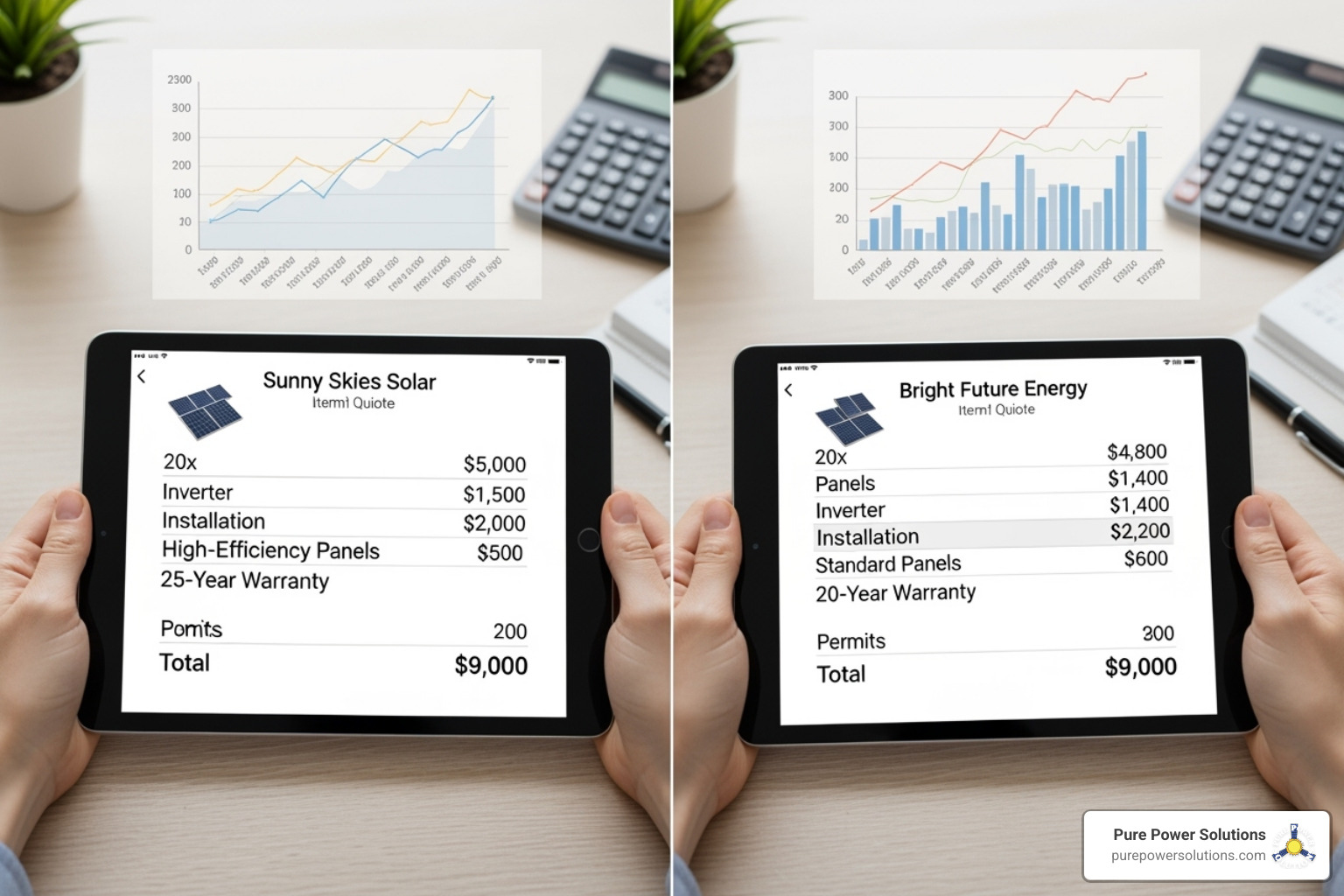
Key Components to Compare in a Commercial Solar Quote
Think of your solar quote as a blueprint for your business’s energy future. Here are the key components to analyze:
-
System Size (kW) and Estimated Annual Production (kWh): The system size is the peak power output, while the production estimate projects how much electricity it will generate annually. These numbers should align with your business’s actual energy consumption and are critical for calculating your savings. Ensure the proposal is based on at least 12 months of your actual utility bills.
-
Total Gross Cost: This is the full system price before incentives. Always ask for a cash price as a baseline for comparison, as financed quotes can sometimes hide dealer fees that inflate the total cost. This figure should be broken down into equipment, labor, and permitting costs.
-
Itemized Equipment List: A solid quote specifies the exact hardware. For panels, look for the brand, model, wattage, and efficiency. Insist on Tier 1 manufacturers, as this indicates financial stability for long-term warranty support. For inverters—the workhorses of your system—the quote should specify the type (string, microinverters, or power optimizers) and brand. The choice impacts performance, monitoring capabilities, and cost. For example, string inverters are cost-effective for large, unshaded roofs, while power optimizers or microinverters maximize output on complex roofs with multiple orientations or shading from HVAC units. The racking system is also important; ensure it’s a reputable brand with a long warranty, designed to protect your roof integrity.
-
Battery Storage: If your quote includes batteries (now common in new commercial installations), it should detail the usable capacity (kWh), power output (kW), brand, and model. Ask about the battery chemistry; Lithium Iron Phosphate (LFP) is often preferred for commercial applications due to its superior safety and longer cycle life. The proposal should also explain how the battery will be used, such as for backup power or, more critically for businesses, for demand charge management to shave expensive peaks in energy use.
-
Monitoring Software: Modern systems include software to track production in real-time. This is a crucial tool for verifying performance against estimates and identifying issues early. The quote should specify the monitoring platform and whether it provides panel-level data.
-
Warranty Information: Your investment is protected by warranties. Look for clear details on the product warranty (covers defects, typically 25 years for panels, 10-25 for inverters), the performance warranty (guarantees a certain output level after 25 years), and a separate workmanship warranty from the installer (covers labor and installation-related issues, should be at least 10 years).
-
Financing Details: If you’re financing, the quote must transparently outline loan terms, interest rates, and any fees. Vague terms are a red flag. Ask for a full amortization schedule.
-
Estimated Incentives: This section should break down all applicable federal, state, and local benefits. The federal Investment Tax Credit (ITC) is substantial for commercial projects. Currently, it’s a 30% credit for projects that start construction prior to July 4, 2026 (with up to four years to complete), or projects started later that are placed in service by December 31, 2027.
For a deeper understanding of what happens after you sign that contract, learn more about the commercial solar installation process.
How to Effectively Compare Solar Panel Quotes for Your Business
Once you’ve gathered multiple quotes, the real work begins. Comparing solar panel quotes isn’t just about finding the lowest number; it’s about creating an “apples-to-apples” comparison to evaluate long-term value, financial performance, and equipment quality. Choosing the lowest bid without this analysis can lead to equipment failures, production shortfalls, and hidden costs that negate any initial savings.
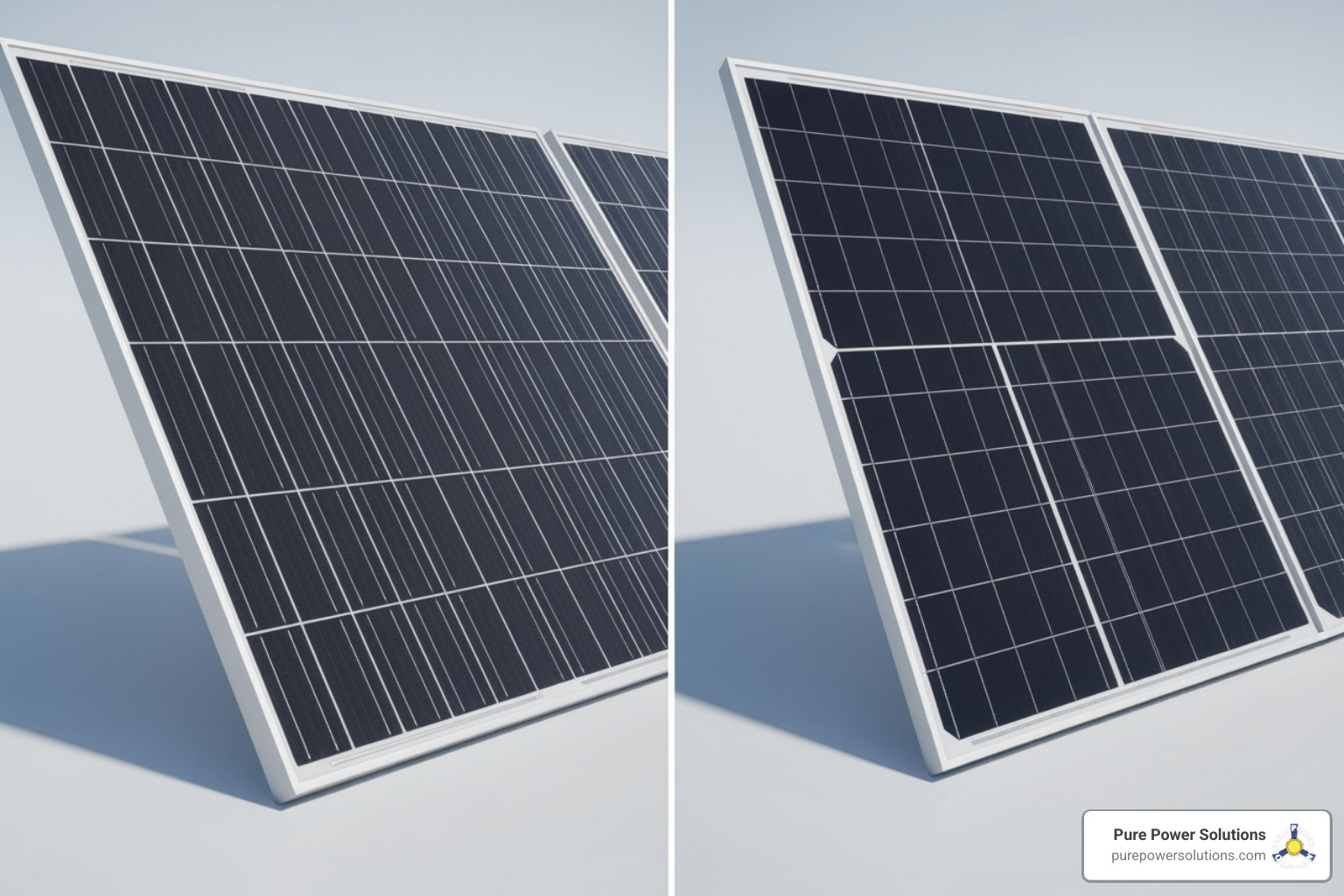
How to compare solar panel quotes using key metrics
To understand the story behind the numbers, focus on these standardized financial metrics:
-
Cost-per-Watt ($/W): Calculate this by dividing the total gross system cost by the system’s size in watts (e.g., a $35,000, 11,000-watt system is $3.18/W). This metric standardizes pricing across different system sizes, making it easy to spot which quotes are competitive. Note that a lower $/W isn’t always better; it could indicate cheaper, less efficient equipment. For commercial projects, this figure can vary based on project complexity, roof type, and labor requirements.
-
Levelized Cost of Energy (LCOE): This metric calculates the average cost of electricity your system will generate over its lifetime, factoring in the initial investment, maintenance, and total production. It is calculated as (Total Lifetime Cost) / (Total Lifetime Energy Production). A lower LCOE indicates better long-term value. This is arguably the most important metric for comparing the true cost of energy from different proposals.
-
Return on Investment (ROI) and Payback Period: ROI tells you how profitable the investment will be, while the payback period estimates how long it will take for energy savings to offset the initial cost. For businesses, it’s crucial that this calculation includes tax benefits like the ITC and the Modified Accelerated Cost Recovery System (MACRS), which allows for accelerated depreciation of the solar asset, significantly improving financial returns. For businesses in our region, payback periods are often between 5 and 10 years, leaving over 15 years of nearly free electricity.
For more context on what drives these numbers, you can read more about the average cost of commercial solar installation.
Evaluating Equipment Quality and Performance Specs
Two quotes with similar prices can deliver vastly different results based on equipment. Look beyond brand names to these key specifications:
-
Panel Efficiency: This measures how effectively a panel converts sunlight into electricity. Higher efficiency means more power in less space, which is crucial for maximizing generation on limited commercial roof areas or offsetting a higher percentage of your energy bill.
-
Temperature Coefficient: Panels lose efficiency as they heat up. A lower temperature coefficient (closer to zero) means better performance on hot summer days, a critical factor in Sonoma and Lake Counties. A panel with a -0.25%/°C coefficient will outperform one with a -0.45%/°C coefficient significantly during peak production hours.
-
Degradation Rate: Panels naturally lose a small amount of efficiency each year. A lower degradation rate (e.g., 0.25% vs. 0.5% annually) can result in thousands of additional kilowatt-hours of production over the system’s life. Check the panel’s 25-year performance warranty; premium panels often guarantee 90% or more of their original output.
-
Inverter Type: String inverters are cost-effective for simple, unshaded roofs. Microinverters or power optimizers (Module-Level Power Electronics or MLPEs) are better for complex layouts or roofs with partial shading, as they allow each panel to operate independently. Hybrid inverters are essential for integrating battery storage, future-proofing your system for resilience and advanced energy management.
Scrutinizing Production Estimates and Savings Projections
Production estimates require healthy skepticism. Verify that the quote’s Energy Usage Assumptions match your business’s actual historical consumption. A professional installer will perform a detailed Shading Analysis specific to your roof using tools like a Solar Pathfinder or drone-based LiDAR, not just a satellite view. This accounts for shading from HVAC units, vents, parapet walls, and nearby trees throughout the day and year. Ask about the Weather Data Source; reputable installers use local, historical data from sources like the National Renewable Energy Laboratory (NREL). Finally, question the Utility Rate Escalation Assumptions used to project savings. A conservative rate of around 3-4% is reasonable; anything higher may be inflating the projections to make the payback period seem shorter than it will be.
Red Flags and Hidden Costs in Commercial Proposals
After three decades in the solar industry, I’ve seen how critical it is to read between the lines of a proposal. While most installers are reputable, certain warning signs can indicate future problems that could cost you thousands or leave you with an underperforming system. A low price can often hide significant risks.
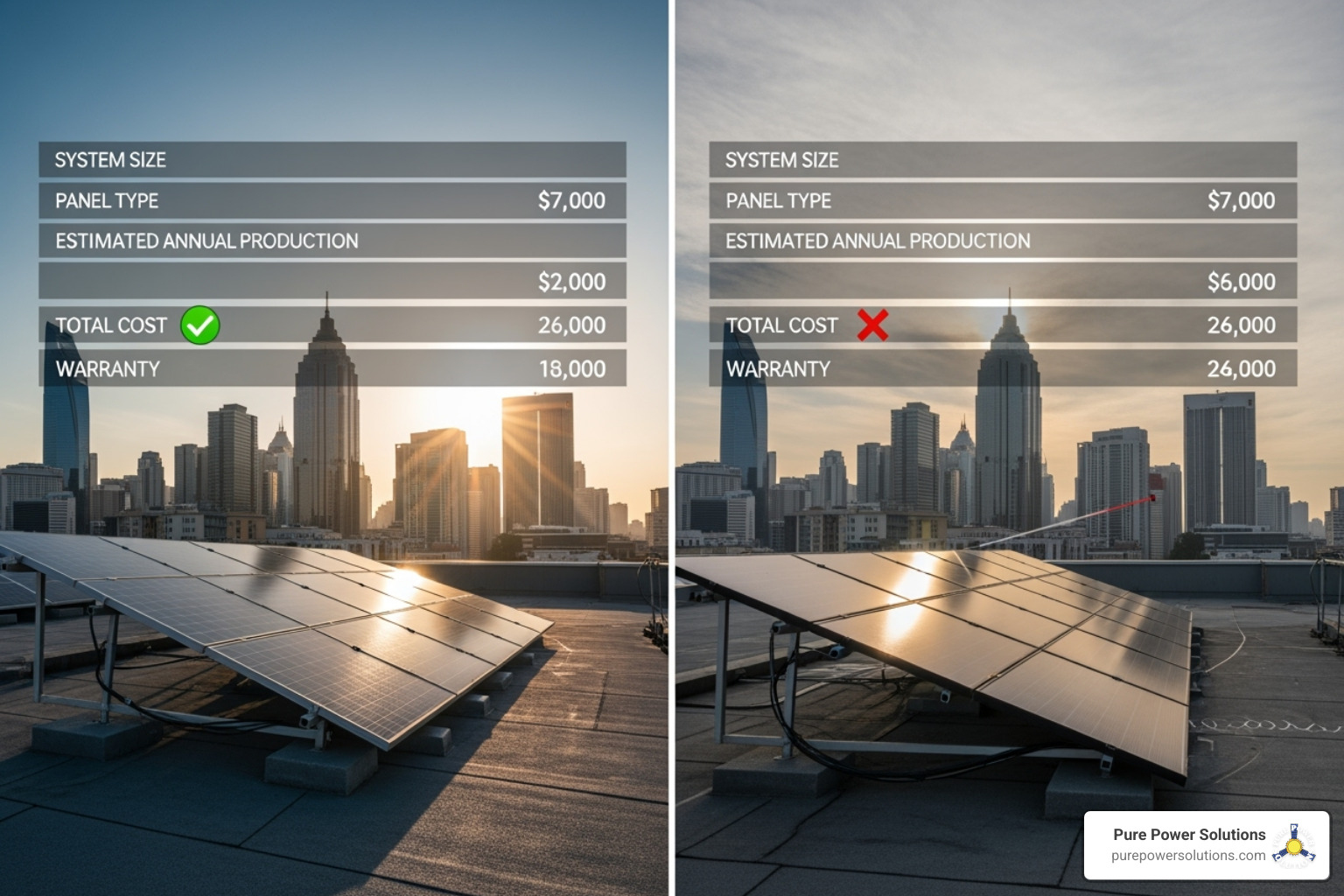
-
Vague proposals are a primary red flag. If a quote lacks specific equipment brands, model numbers, or clear warranty information, be cautious. A proposal that says “100kW DC System” is not enough; it should specify “223 x Brand X Model Y 450W panels.” A legitimate installer is proud to detail what you’re buying.
-
Proposals without a site visit are a major concern. A quote generated solely from satellite imagery cannot account for the condition of your roof, the state of your electrical panels, or subtle shading obstacles. A professional company will insist on a thorough site survey before providing a final, binding quote.
-
High-pressure tactics, like “price is only good today” offers, are unprofessional. A significant capital investment requires time for you to compare solar panel quotes and make an informed decision. Rushed decisions often lead to regret.
-
Unrealistic guarantees, such as promising you’ll “never pay an electric bill again,” are misleading. Most grid-tied systems still incur small monthly utility connection fees, and system output can vary. Look for a production guarantee backed by data, not a vague savings promise.
-
Aggressive timelines can signal that an installer might be cutting corners. Quality commercial installation involves careful engineering, permitting, utility approvals, and workmanship, which takes time. Ask for a detailed project schedule and be wary of anyone promising an impossibly fast turnaround.
-
Proprietary equipment can lock you into a single provider for future service or expansion. We prefer industry-standard components that any qualified technician can work with, protecting your long-term flexibility and ensuring competitive service costs down the line.
For more guidance on selecting a trustworthy partner, learn more about how to choose the right solar company for you.
Understanding Dealer Fees and Rate Escalators
Two financial traps can dramatically inflate your costs. Hidden financing costs, often called dealer fees or points, are charges added to a loan to cover the lender’s costs. This inflates your loan principal, meaning you pay interest on the fee itself. A $100,000 system might become a $120,000 loan to get a lower interest rate, wiping out the benefit. Always ask for the cash price as a baseline and compare it to the total financed amount to identify these fees.
Rate escalators, common in lease or Power Purchase Agreement (PPA) agreements, mean your payment increases by a set percentage each year. A seemingly small 2.9% annual escalator can dramatically increase your total cost of ownership over a 25-year term, potentially making your solar payment higher than the utility rate in the later years of the contract. Always ask for a year-by-year payment breakdown to understand the true long-term cost.
Frequently Asked Questions about Comparing Commercial Solar Quotes
We’ve been helping businesses with solar installations for over 30 years, and we know the questions that arise when you’re ready to compare solar panel quotes. Let’s tackle the most common concerns to empower you in your decision-making process.
How do I verify a solar production estimate’s accuracy?
Not all production estimates are created equal. Independent verification is your best tool. You can start with the free and trusted PVWatts Calculator from NREL (National Renewable Energy Laboratory). This tool provides a baseline for how much electricity a system should produce at your specific location, using historical weather data.
When you compare solar panel quotes, ask each installer about their assumptions for weather data, shading, soiling (dirt accumulation), and panel degradation. Significant discrepancies in production estimates often stem from different assumptions. A reputable installer will conduct a thorough on-site assessment to analyze your actual roof conditions and shading patterns from HVAC units, vents, and nearby structures, not just rely on satellite imagery. They should be able to provide a detailed shade report from their design software.
What questions should I ask an installer about their quote?
Treat this as a job interview for a 25+ year partnership. Key questions include:
- Costs: “Can you provide an itemized breakdown of all costs, including equipment, labor, permitting, and any financing fees? What is the cash price versus the financed price?”
- Equipment: “What are the exact makes and models of the panels, inverters, and any batteries? Why did you choose this equipment for my specific project?”
- Design: “How did you determine this specific system size and design for my business’s energy needs? Can you show me the shade analysis you performed?”
- Savings: “What are your assumptions for future electricity rate increases in my savings projections? What is the degradation rate you used for the panels?”
- Warranties: “What are the terms of your workmanship warranty, what does it cover, and who services the equipment warranties?”
- Credentials: “Are your installers NABCEP certified?” and “Can you provide references from other local commercial clients with similar systems?”
What is the utility interconnection process and who handles it?
A professional solar installer should act as your agent and manage the entire interconnection process with the utility. This involves submitting a detailed application package, which includes single-line diagrams, engineering specifications, and equipment cut sheets. The utility reviews this package to ensure the proposed system can be safely connected to the grid. This process can take weeks or even months and is a critical step before installation can be completed. For larger commercial systems, the utility may require a grid impact study, and in some cases, costly grid upgrades may be necessary. Your installer should identify and communicate these potential requirements and costs early in the process.
How will a solar installation affect my roof warranty and property insurance?
This is a critical consideration for any building owner. A reputable installer will use mounting and flashing techniques that are approved by major roofing manufacturers to maintain the integrity of your roof warranty. They should also provide a robust workmanship warranty that explicitly covers any roof penetrations they make for a period of at least 10 years. Before signing a contract, you should inform your property insurance provider about the project. The solar array is a significant asset that needs to be added to your policy. While this may result in a modest increase in your premium, it is essential for protecting your investment against damage or liability.
How does the commercial solar tax credit work?
The Investment Tax Credit (ITC) is a powerful incentive for commercial solar projects. It is a dollar-for-dollar reduction in your income tax liability.
Commercial solar projects will be eligible for the 30% tax credit provided certain deadlines are met. Starting construction prior to July 4, 2026 provides the most time to complete work (four years). Commercial projects starting construction after July 4, 2026 would need to be placed in service prior to 12/31/2027 in order to qualify.
This 30% credit applies to the total cost of your system, including panels, inverters, racking, battery storage, and installation labor. Given that commercial projects take several months to complete, starting the process sooner rather than later is prudent to ensure you don’t miss out on this significant incentive due to scheduling or permitting delays. To claim the credit, your business must have sufficient tax liability.
For more information on how these incentives make solar financially compelling, explore more info about why solar is a good investment.
Conclusion: Selecting the Right Solar Partner for Your Business
When you compare solar panel quotes, you’re choosing more than just equipment; you’re choosing a partner for the next 25+ years. This long-term relationship is critical, as a solar system is a major asset that will impact your bottom line for decades. The cheapest quote rarely delivers the best long-term value. Instead, it often introduces risks of underperformance, premature equipment failure, and an unresponsive service provider.

Your final decision should be based on a holistic view of value. Focus on quality equipment with strong performance specs and warranties. Scrutinize the financial metrics like LCOE and ROI, ensuring they are based on conservative and transparent assumptions. Most importantly, select an installer with a proven track record, deep engineering expertise, and a commitment to being your partner for the long haul. At Pure Power Solutions, our 30 years of experience in Sonoma, Napa, Mendocino, and Lake County has taught us that a personalized approach is essential. We design custom systems that align with your unique energy needs, building structure, and business goals.
We are committed to helping businesses achieve energy independence with reliable, high-performing systems installed with pride and backed by service that lasts. When you’re ready to move forward with solar, we would be honored to earn your trust with a detailed, transparent quote you can confidently compare.
Contact Pure Power Solutions today for a free consultation. Visit our website at https://purepowersolutions.com or call us at 707-658-2157.


