

Why Businesses Need Commercial Battery Storage
Picture this: your business is humming along perfectly when suddenly the lights flicker and everything goes dark. Or maybe you open your monthly electricity bill and nearly choke on your coffee when you see those peak demand charges. Sound familiar?
This is exactly why more businesses across Sonoma, Napa, Mendocino, and Lake County are making battery storage comparison a top priority. It’s not just about having solar panels anymore – it’s about making that clean energy work around the clock for your bottom line.
Think of commercial battery storage as your business’s energy insurance policy, financial advisor, and efficiency expert all rolled into one. When your solar panels are cranking out power during those sunny California afternoons, your batteries are quietly storing every extra kilowatt for later use. It’s like having a savings account, but for electricity.
Peak demand charges are often the biggest shock on commercial electricity bills. These charges hit you based on your highest energy usage in just a 15-minute window during the entire billing cycle. One busy afternoon when all your equipment is running full throttle, and boom – you’re paying premium rates all month long. Battery storage acts as your energy buffer, automatically kicking in during these peak moments to keep your demand charges in check.
The beauty of time-of-use arbitrage becomes clear when you realize that electricity prices dance up and down throughout the day like a stock ticker. Your batteries can store power when rates are low (often during sunny midday hours when solar production is high) and release it when prices spike in the evening. It’s like buying wholesale and avoiding retail prices every single day.
Backup power isn’t just about keeping the lights on – it’s about protecting your reputation and revenue. When the grid goes down, your refrigeration systems keep running, your security systems stay active, and your manufacturing lines don’t skip a beat. Your customers never know there was even a problem, while your unprotected neighbors are scrambling with flashlights.
Here’s where it gets really exciting: maximizing your solar investment means capturing every ray of sunshine that hits your roof. Without storage, excess solar energy gets sent back to the grid for pennies on the dollar through net metering. With batteries, you’re essentially getting paid full retail price for every kilowatt-hour your panels produce, because you’re using it to offset expensive grid electricity later.
Some forward-thinking businesses are even earning grid services revenue by participating in programs that help stabilize the electrical grid. Your battery system can provide valuable services to utility companies during peak demand periods, turning your energy storage into an additional revenue stream.
Learn more about Commercial Solar Battery Storage.
Why Battery Storage Comparison Matters for Your Business
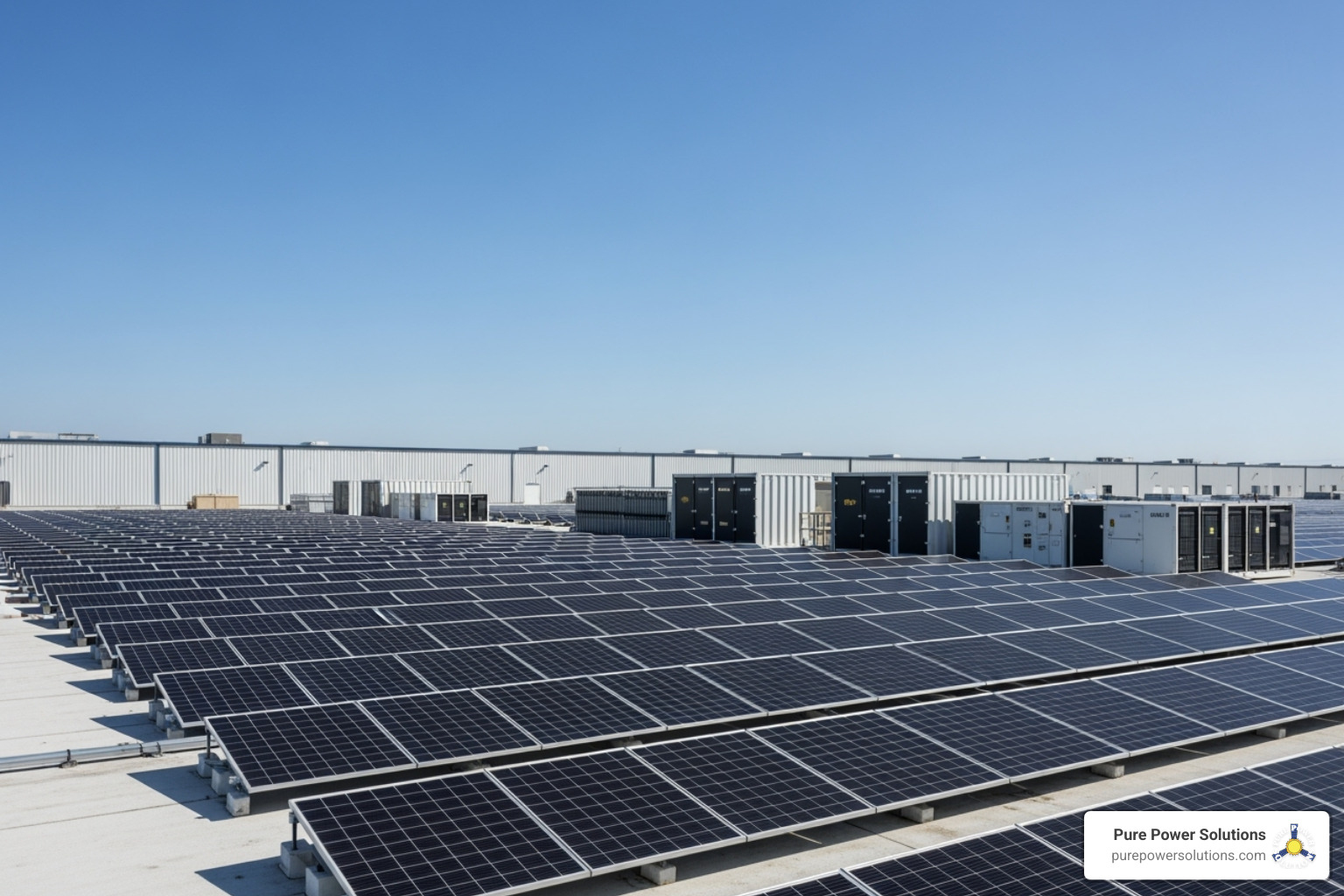
Battery storage comparison is essential for businesses looking to maximize their solar investment and reduce energy costs. Here’s what you need to know:
Key Comparison Factors:
- Capacity: How much energy the battery can store (kWh/MWh)
- Power Rating: How much energy it can deliver at once (kW)
- Efficiency: Round-trip efficiency typically ranges from 85-97%
- Lifespan: Most commercial batteries last 10-20 years
- Chemistry: LFP batteries offer safety and longevity, while NMC provides higher energy density
- Coupling: AC-coupled for retrofits, DC-coupled for new installations
Nearly two-thirds of solar customers now pair their systems with battery storage to maximize energy independence and cost savings. With rising electricity rates and increasing grid instability, businesses need reliable backup power and the ability to shift energy usage to avoid peak demand charges.
The most important technical specifications to consider include usable capacity, continuous and peak power ratings, round-trip efficiency, and depth of discharge. Different battery chemistries like Lithium Iron Phosphate (LFP) and Nickel Manganese Cobalt (NMC) offer distinct advantages for commercial applications.
I’m Rody Jonas, owner of Pure Power Solutions, and I’ve been helping businesses steer battery storage comparison decisions since 1993. With over 30 years of experience designing renewable energy systems across Northern California, I understand how critical it is to match the right battery technology to your specific business needs.
A Comprehensive Battery Storage Comparison for Commercial Applications
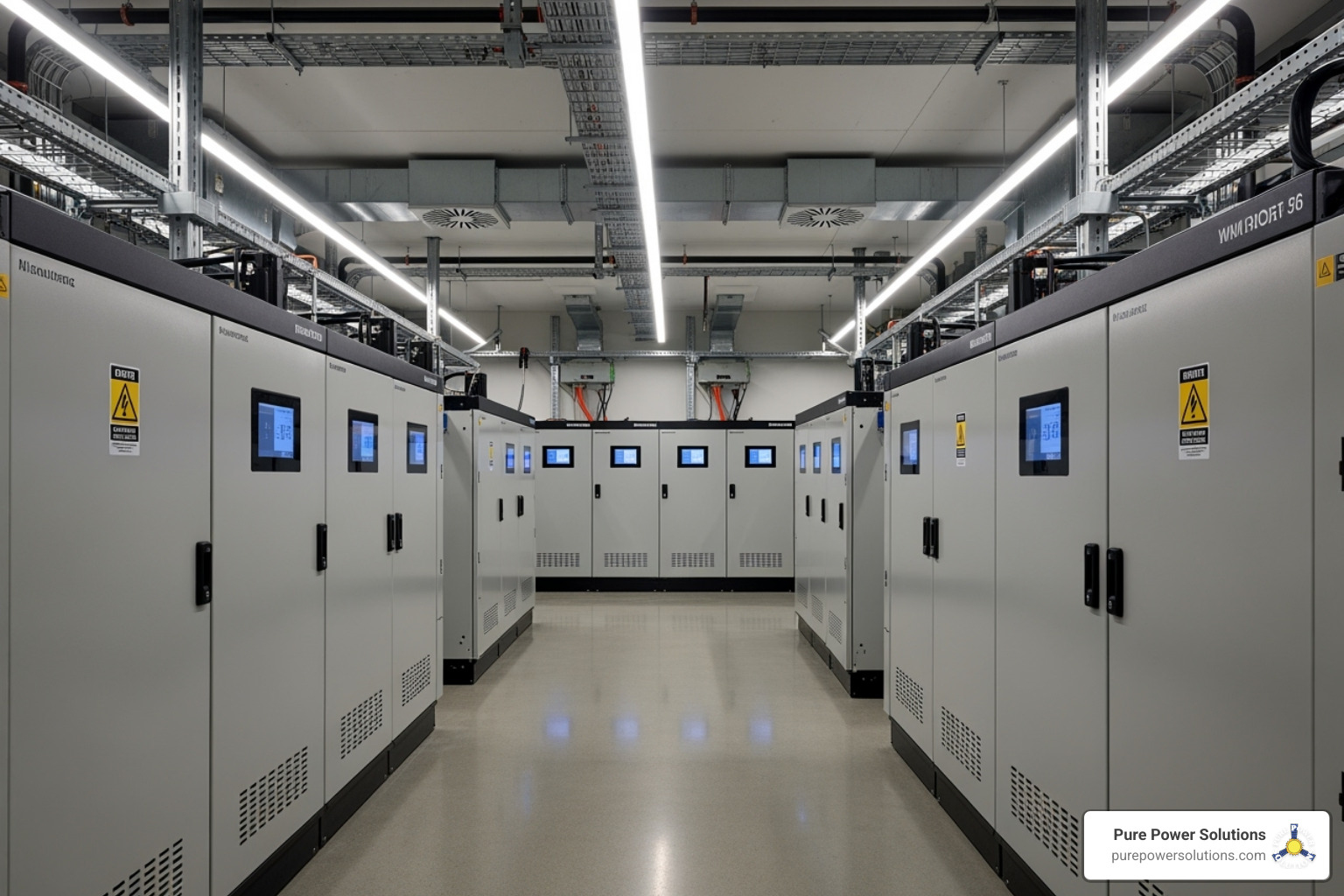
Walking into a modern commercial battery storage facility, you’re struck by the quiet hum of advanced technology working around the clock to optimize energy costs and ensure business continuity. These sleek units represent the culmination of decades of battery innovation, and choosing the right system requires understanding what makes each one unique.
When I help businesses steer their battery storage comparison, I always start with the fundamentals. Think of it like buying a truck for your business – you wouldn’t just look at the price tag. You’d want to know how much it can carry, how fast it can go, and how long it will last. Battery systems work the same way.
Key Technical Specifications for Your Battery Storage Comparison
The heart of any effective battery storage comparison lies in understanding the technical specifications that directly impact your business operations. Let me walk you through what really matters.
Usable capacity is your starting point – measured in kilowatt-hours (kWh) for smaller systems or megawatt-hours (MWh) for larger facilities. This tells you exactly how much energy your battery can store and deliver when you need it most. A small office might need 30 kWh to cover essential operations during an outage, while a manufacturing facility could require 500 kWh or more to maintain production lines.
The continuous power rating determines how much energy your battery can deliver at any given moment. Picture this: if your facility needs to run multiple pieces of equipment simultaneously during peak hours, you need a battery with enough continuous power output to handle that load. Most commercial systems range from 10 kW for smaller operations up to several hundred kW for large facilities.
Here’s where things get interesting – peak power rating covers those critical moments when equipment first starts up. Your HVAC system or industrial machinery might need a sudden surge of power that’s much higher than their normal operating requirements. Advanced systems can deliver up to 200% of their continuous rating for short bursts, ensuring your operations never skip a beat.
Round-trip efficiency is where the rubber meets the road financially. This metric shows you how much energy gets lost in the charging and discharging process. Modern systems achieve 85-97% efficiency, meaning that for every 10 kWh you store, you’ll get 8.5 to 9.7 kWh back out. DC-coupled systems typically reach the higher end of this range, while AC-coupled systems fall slightly lower but offer other advantages we’ll discuss.
Most lithium-ion batteries today allow for 80-100% depth of discharge without impacting their lifespan. This means you can use nearly all the stored energy before needing to recharge – a significant improvement over older battery technologies that required you to leave substantial capacity unused.
The cycle life and throughput specifications tell the story of your battery’s longevity. Cycle life indicates how many complete charge-discharge cycles your battery can handle before capacity drops to 60-80% of original performance. Quality lithium-ion systems typically offer 4,000 to 6,000 cycles. Throughput guarantees, measured in MWh, provide an even clearer picture by specifying the total energy your battery will deliver over its lifetime.
Scalability becomes crucial as your business grows. The best systems allow you to add battery modules seamlessly, expanding capacity and power output without replacing your entire investment. This modularity ensures your energy storage solution evolves with your operations.
For more details, see How Battery Systems Work.
System Architecture: Coupling and Chemistry
The way your battery integrates with existing solar installations and the chemistry powering it fundamentally shapes performance and cost-effectiveness.
AC-coupled systems shine when retrofitting existing solar installations. These systems include integrated inverters, making them incredibly versatile for businesses that already have solar panels but want to add storage capabilities. If your facility uses microinverters or you’re looking to add storage without overhauling your entire electrical setup, AC-coupling offers the most straightforward path forward. While there’s a slight efficiency trade-off due to multiple energy conversions, the installation simplicity often makes this the most cost-effective choice for retrofits.
DC-coupled systems represent the efficiency champion for new installations. When you’re designing a complete solar-plus-storage system from scratch, DC-coupling minimizes energy conversion losses by allowing solar electricity to flow directly into the battery before being converted to AC for building use. This single conversion process can achieve round-trip efficiencies up to 97.5%, translating to meaningful cost savings over the system’s lifetime.
The battery chemistry debate often comes down to Lithium Iron Phosphate (LFP) versus Nickel Manganese Cobalt (NMC). LFP batteries have become the gold standard for commercial applications due to their exceptional safety profile and longevity. They’re remarkably stable, resistant to overheating, and can last 14-16 years in moderate climates with daily cycling. Recent market developments have made LFP cells approximately 30% more cost-effective than other lithium chemistries for stationary storage applications.
NMC batteries excel in energy density, storing more power in a smaller footprint. This advantage becomes valuable when space constraints are severe, but it comes with trade-offs in thermal stability and lifespan compared to LFP systems.
For an authoritative study on battery lifetime expectancy, see MDPI: Battery Lifetime Expectancy.
Evaluating Long-Term Value in Your Battery Storage Comparison
The true measure of a commercial battery investment lies not in the upfront cost, but in the value delivered over its operational lifetime. Smart businesses look beyond the initial price tag to understand total cost of ownership.
Warranty coverage provides your financial protection, with most commercial systems offering 10-20 year warranties. However, the devil lies in the details – specifically the throughput guarantee. This specification defines the total energy (in MWh) your battery is guaranteed to deliver over its warranted life, regardless of how frequently you cycle it. This protection ensures heavy daily users get the same warranty value as occasional users.
End-of-life capacity retention typically guarantees 60-80% of original capacity at warranty expiration. Understanding this helps predict when you might need system augmentation or replacement, allowing for better long-term financial planning.
The cost per kWh metric enables accurate comparisons between different systems by factoring in actual usable capacity. Quality commercial systems typically range from $650-$800 per kWh of usable capacity before installation and incentives.
Installation and balance-of-system costs can significantly impact total project investment. These include electrical upgrades, permits, monitoring equipment, inverters for DC-coupled systems, and skilled installation labor. Working with experienced installers helps ensure these costs are properly estimated and controlled throughout the project.
Maximizing ROI: Incentives and Sizing
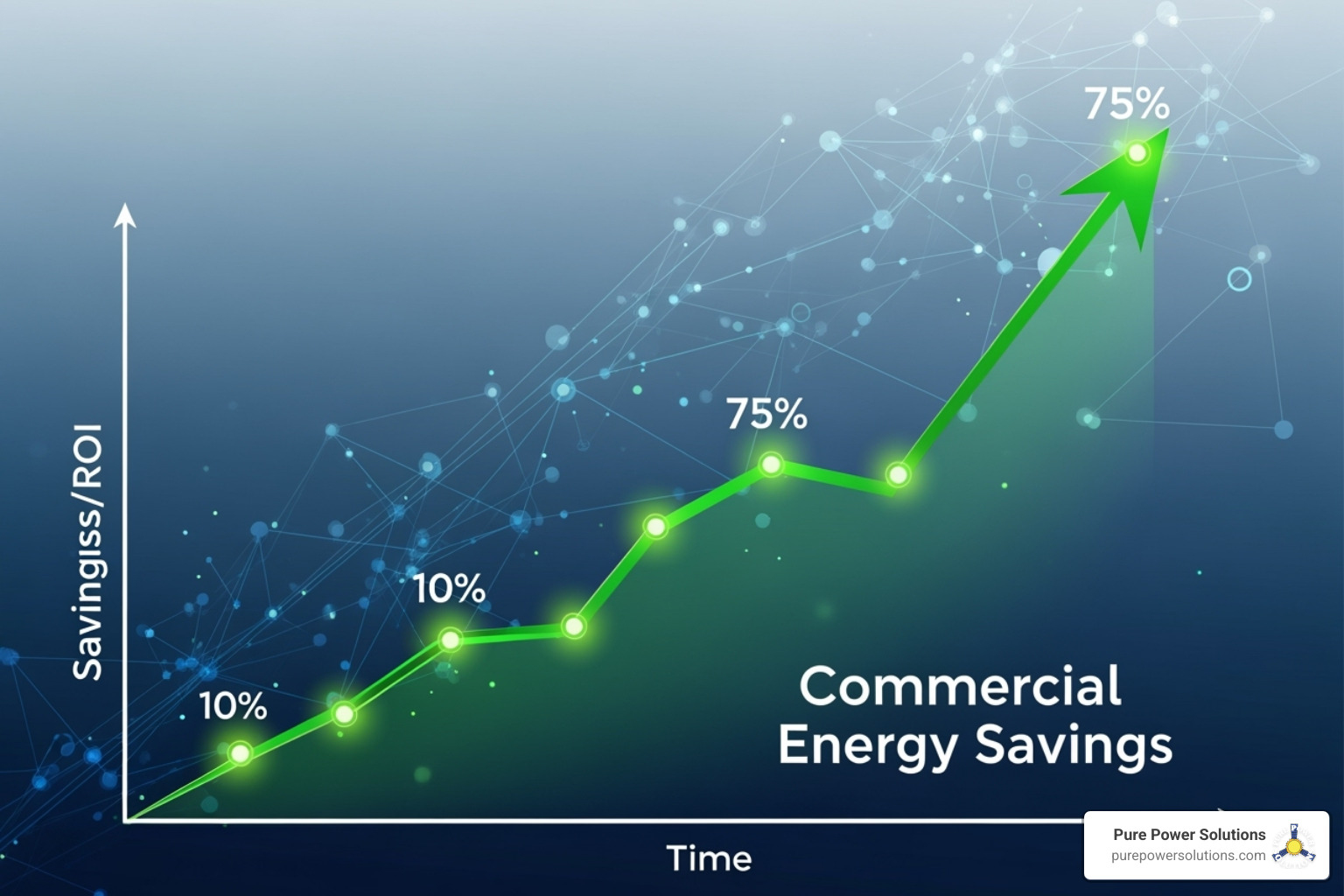
When it comes to commercial battery storage comparison, the numbers need to make sense for your bottom line. After three decades of helping businesses steer renewable energy investments, I’ve seen how the right combination of smart incentives and proper system sizing can transform a good investment into an exceptional one.
The financial landscape for commercial energy storage has never been more favorable. Between federal tax credits, state incentives, and the long-term savings from reduced energy costs, many of our clients see payback periods that would make any CFO smile. But here’s the thing – maximizing your return requires understanding both the incentives available and getting your system size exactly right.
Leveraging the Commercial Solar Tax Credit
The federal Investment Tax Credit remains one of the most powerful financial incentives available to businesses investing in solar and battery storage. This isn’t just a deduction – it’s a direct credit against your federal tax liability, which means substantial immediate savings.
Here’s what makes this particularly compelling: the credit applies to the entire system cost, including both solar panels and battery storage. For a typical commercial installation, this can translate to tens of thousands of dollars in tax savings.
Beyond the federal credit, many California businesses can layer additional state and local incentives. The Self-Generation Incentive Program (SGIP) specifically targets energy storage systems, offering rebates that can further reduce your net investment. When we work with clients in Sonoma, Napa, and Lake County, we always ensure they’re capturing every available incentive dollar.
The math is compelling: a business investing $100,000 in a commercial solar and battery system could see an immediate $30,000 federal tax credit, plus additional state incentives. This dramatically accelerates your payback timeline and improves your overall return on investment.
How to Correctly Size Your System
Getting the sizing right is where the art meets the science in battery storage comparison. I’ve seen businesses make costly mistakes by either under-sizing their systems and missing out on savings, or over-sizing and tying up unnecessary capital. The sweet spot requires a detailed understanding of your specific energy profile.
Analyzing utility bills and demand charges forms the foundation of our sizing process. Your electricity bills tell a story – when you use the most power, what your peak demand looks like, and how time-of-use rates affect your costs. Those demand charges can be particularly brutal for commercial customers, sometimes representing 30-50% of your total electricity bill. A properly sized battery system can shave those peaks and deliver immediate monthly savings.
Identifying critical business loads becomes especially important when we’re designing for backup power capability. Not every piece of equipment needs battery backup – but your critical systems absolutely do. We work with you to map out what must stay running during an outage: your IT infrastructure, security systems, refrigeration, or essential manufacturing equipment. This analysis ensures your battery system can handle these loads for the duration you need.
Calculating daily energy consumption patterns helps us determine the optimal battery capacity. If your business uses 200 kWh per day and you want to maximize solar self-consumption, we might recommend a battery system that can store 80-120 kWh – enough to shift your daytime solar production to evening hours when electricity rates are highest.
Planning for future business growth is where many businesses miss opportunities. Are you expanding operations? Adding new equipment? Planning to electrify your vehicle fleet? We design systems with scalability in mind, so you can add battery modules as your energy needs grow without starting from scratch.
However, every business is unique, and the most accurate sizing requires a professional assessment that considers your specific operations, utility rate structure, and growth plans.
The goal isn’t just to install a battery system – it’s to install the right battery system that delivers maximum value for your specific situation. When we get the sizing right, the financial returns follow naturally.
Installation and Off-Grid Considerations
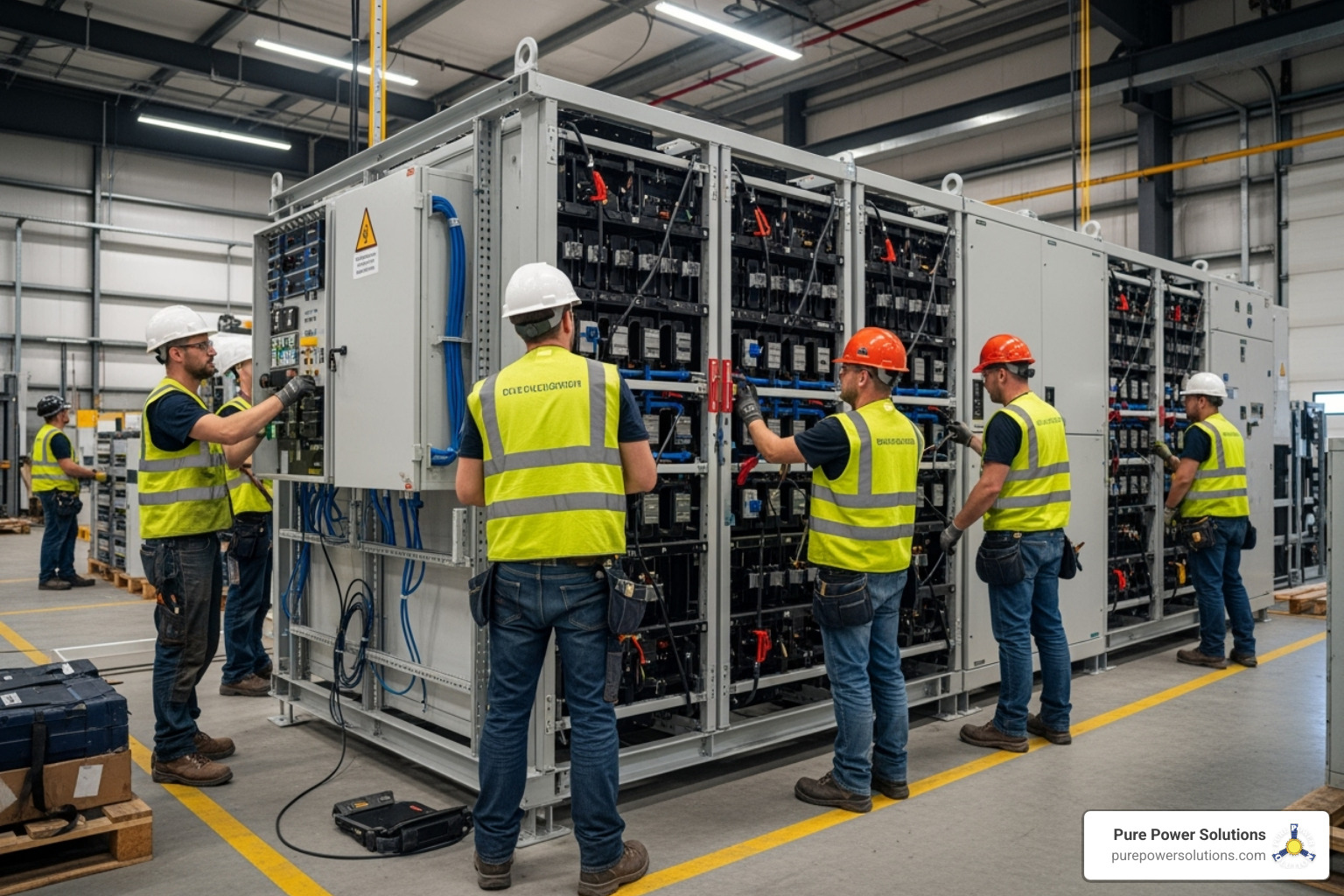
Once you’ve completed your battery storage comparison and selected the ideal system for your business, the installation phase becomes your pathway to energy independence. This isn’t the kind of project you tackle over a weekend – commercial battery installation requires deep expertise in electrical engineering, local regulations, and the intricate dance of grid interconnection.
Having spent three decades working across Northern California, I’ve seen how proper installation can make or break even the best battery system. Every wire placement matters, every connection counts, and every permit detail can impact your system’s performance for years to come.
The Installation Process in Sonoma, Napa, and Lake County
Our installation process has been refined through hundreds of commercial projects across these wine country regions. Each county has its own personality when it comes to regulations, and we’ve learned to steer them all seamlessly.
The journey begins with a comprehensive site assessment where we examine every aspect of your property that could influence the installation. We’re looking at available space for equipment, evaluating structural integrity for mounting systems, and measuring proximity to your existing electrical infrastructure. If you already have solar panels, we carefully assess how your new battery system will integrate with your current setup.
Local permitting requirements vary significantly between Sonoma, Napa, and Lake County, and each municipality within these counties often has its own specific building codes and electrical regulations. We handle all the paperwork maze so you don’t have to. Our relationships with local permitting offices mean we know exactly what documentation each jurisdiction expects, helping avoid the delays that can plague less experienced installers.
Structural engineering becomes critical when we’re mounting battery units on rooftops or securing them to walls. We ensure your building can safely support not just the weight of the batteries themselves, but also the mounting hardware and any future maintenance access requirements. Safety isn’t negotiable in our book.
The electrical integration phase is where our certified electricians really shine. They carefully weave the battery system into your existing electrical ecosystem, connecting it to your main electrical panel, solar inverter, and critical load panels. This integration needs to be seamless – you should never notice when your building switches between grid power, solar power, and battery power.
Finally, grid interconnection involves working with your utility provider to ensure your system can safely and legally connect to the grid. This process enables net metering benefits and opens the door for participation in demand response programs that can generate additional revenue for your business.
Is an Off-Grid System Right for Your Business?
While most businesses benefit from grid-tied battery systems, some operations find themselves drawn to the ultimate energy independence that comes with going completely off-grid. It’s a bold step, but for the right business, it can be transformative.
The energy independence benefits are undeniable – your business becomes entirely self-sufficient, drawing all its power from your solar panels and battery storage. You’re completely immune to power outages, utility rate increases, and grid instability. For businesses where even brief power interruptions can mean significant losses, this level of control is invaluable.
However, system requirements for full off-grid operation are substantially more demanding than grid-tied systems. We need to size your battery bank to handle not just your daily energy needs, but also extended periods of low solar production during cloudy stretches or seasonal variations. The system requires robust charge controllers and dedicated off-grid inverters designed for continuous, reliable operation. While the initial investment is higher, the long-term benefits of complete energy autonomy often justify the cost.
Generator integration for reliability provides the ultimate safety net in off-grid configurations. We typically recommend a backup generator that automatically kicks in if your battery bank runs low during prolonged periods of insufficient solar production. This hybrid approach gives you the best of both worlds – clean, silent solar power as your primary energy source, with the peace of mind that comes from knowing you have reliable backup power for critical operations.
Learn more about Off-Grid Solar Energy Storage Systems and The Off-Grid Dream: How to Make Electricity with Solar Power and Battery Storage.
Conclusion
After walking through this comprehensive battery storage comparison guide, you’re now equipped with the knowledge to make an informed decision about commercial battery storage for your business. We’ve covered the essential technical specifications that matter most—from usable capacity and power ratings to the nuances of AC-coupled versus DC-coupled systems and why LFP chemistry offers such compelling advantages for commercial applications.
The financial picture is equally important, and we’ve explored how the 30% federal tax credit can significantly reduce your investment costs. Correctly sizing your system based on your actual energy consumption patterns and peak demand charges is what separates a good investment from a great one.
What strikes me most after three decades in this industry is how much the battery storage comparison landscape has evolved. The systems we’re installing today offer unprecedented reliability, efficiency, and value. Whether you’re looking at a grid-tied system to reduce peak demand charges and maximize your solar investment, or considering the ultimate energy independence of an off-grid setup, the technology has matured to meet virtually any commercial need.
Your business deserves a battery storage solution that’s as unique as your operations. There’s no cookie-cutter approach here—every system we design is carefully custom to your specific energy patterns, critical load requirements, and growth projections. The combination of reduced energy costs, backup power protection, and potential grid services revenue creates multiple pathways to return on investment.
The installation process in Sonoma, Napa, and Lake County doesn’t have to be overwhelming when you work with experienced professionals who understand local permitting requirements and utility interconnection procedures. We’ve steerd these waters thousands of times, and we’re here to make your transition to energy storage as smooth as possible.
Looking ahead, commercial battery storage isn’t just about today’s savings—it’s about positioning your business for an energy future that’s increasingly focused on resilience, sustainability, and cost control. The businesses that invest in quality battery storage systems today are the ones that will thrive as energy costs continue to rise and grid reliability becomes more challenging.
With over 30 years of experience designing and installing commercial and off-grid systems in Northern California, Pure Power Solutions is your trusted partner in this journey. We pride ourselves on taking the time to understand your unique needs and delivering solutions that exceed expectations.
Contact Pure Power Solutions today for a free consultation. Visit our website at https://purepowersolutions.com/ or call us at (707) 433-6556.


