

Navigating Solar Battery Pricing for Your Business
When considering solar battery pricing for your business, it helps to start with clear expectations about scope, performance, and long-term value. The initial investment is just one part of a larger financial equation. A truly valuable energy storage solution is measured not by its upfront cost, but by its Total Cost of Ownership (TCO) and the return it delivers over a 15- to 20-year lifespan. In 2025, a fully installed commercial battery energy storage system (BESS) typically ranges from about $12,000 to $20,000 for small commercial use cases, with the battery unit itself often priced from $6,000 to $18,000 depending on chemistry, usable capacity, and integrated electronics. For planning purposes, many projects pencil out near $1,300 per kWh before incentives—and frequently closer to $1,000 per kWh after incentives are applied.
Beyond these headline figures, commercial viability hinges on how storage is integrated and operated. A battery is not a passive appliance; it’s an active financial asset. It can protect critical loads during grid outages, preventing costly downtime and inventory loss. It can be strategically dispatched to shave expensive demand charges, which often constitute a significant portion of a commercial utility bill. It can also arbitrage time-of-use rates by storing low-cost energy (from solar or the grid) and using it during peak-price hours. Finally, it maximizes the on-site consumption of clean solar generation, reducing reliance on the utility. Each of these use cases changes the optimal system size, operating strategy, and therefore the total investment. That’s why site-specific engineering, a detailed utility tariff analysis, and precise load prioritization are essential parts of the pricing conversation.
I’m Rody Jonas, owner of Pure Power Solutions. For more than 30 years, our team has helped organizations across Sonoma, Lake, Napa, and Mendocino Counties design and deploy reliable commercial solar-plus-storage systems. We specialize in creating resilient, battery-based solutions that align with your specific operational priorities—whether that’s safeguarding revenue-critical processes, reducing exposure to volatile utility pricing, or achieving corporate sustainability goals. Our goal is to translate the complexity of solar battery pricing into a clear, actionable business case that your leadership team can act on with confidence.
Viewed through a commercial lens, cost is never just about the battery box. Your bottom line is shaped by the complete ecosystem of components and services. This includes balance-of-system hardware like inverters and switchgear, necessary electrical upgrades to your facility, sophisticated software controls for optimization, as well as the costs of permitting, commissioning, and life-cycle maintenance. A well-engineered solution avoids stranded capacity (buying more storage than you’ll actually use), targets the highest-value hours for dispatch, and ensures full compliance with current codes and standards—all of which directly influence both the upfront price and your long-term returns.
The sections below break down current price ranges, what drives those numbers, how to leverage incentives and financing, and how to decide if storage is the right strategic investment for your facility. Where helpful, we include links to deeper technical explanations and planning resources on our website, along with quotes and references from authoritative sources. According to the U.S. Department of Energy, \”Energy storage technologies are critical for building a resilient and flexible grid that can integrate increasing amounts of renewable energy.\”
Understanding Solar Battery Prices in 2025
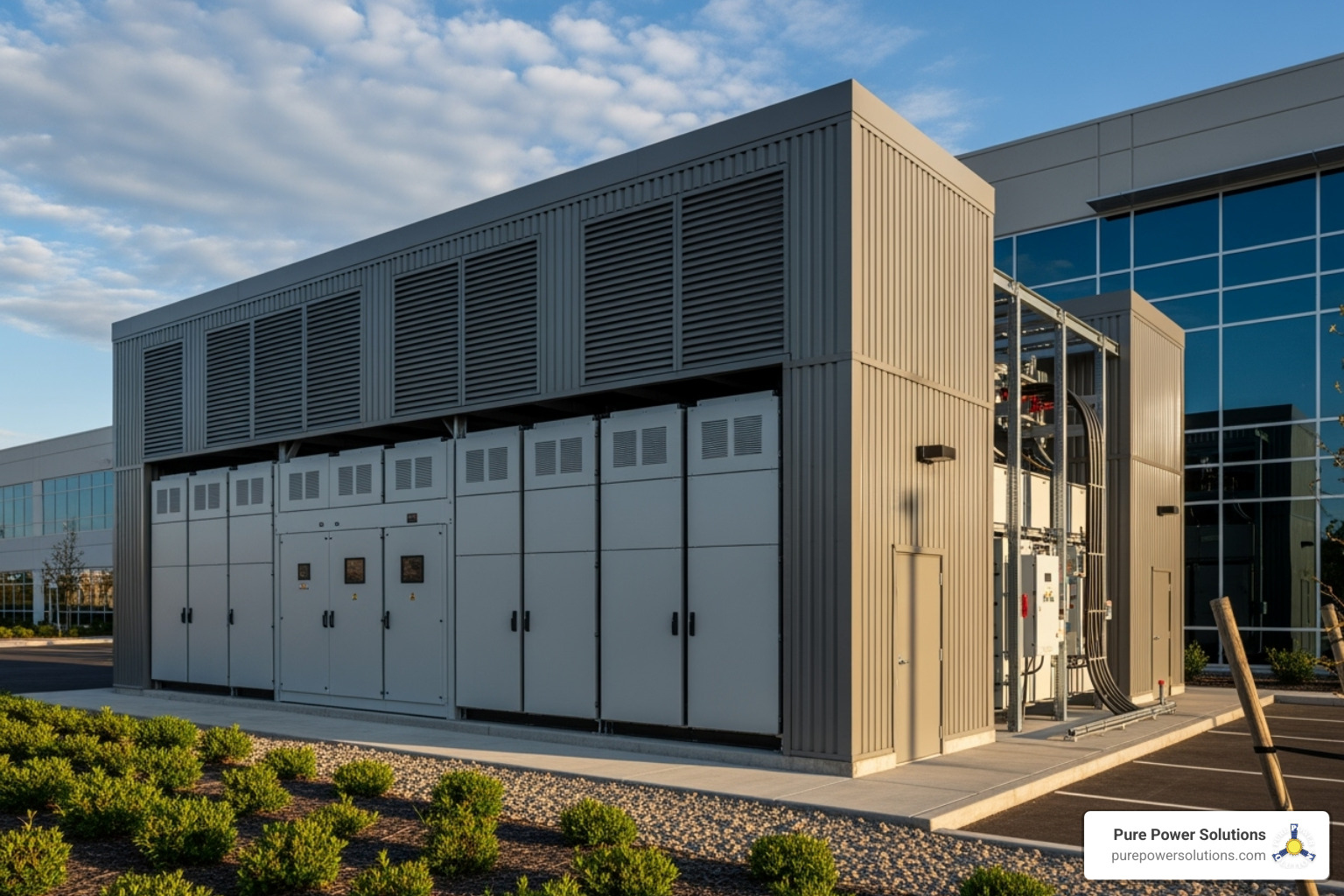
As we step into 2025, solar battery pricing reflects two countervailing forces: the steady maturation of technology that lowers cost per kWh over time, and increased project complexity as businesses seek richer functionality. While advancements in cell manufacturing and supply chains continue to drive down the core cost of battery hardware, the demand for sophisticated features like predictive demand charge management, seamless critical-load backup, and integrated grid-service controls adds to engineering and software costs. Typical small commercial systems install in the $12,000–$20,000 range, but the appropriate budget depends primarily on energy capacity (kWh), power rating (kW), required duty cycle, and the complexity of integration with existing solar and facility electrical systems.
Two useful yardsticks help frame initial expectations:
- Cost per kWh before incentives: This all-in figure for a turnkey system is approximately $1,300 for many commercial-scale projects using mainstream lithium-ion chemistries. This number typically bundles the battery, inverter, basic installation labor, and project management.
- Cost per kWh after incentives: This net cost often falls near $1,000, depending on the system design and the organization’s ability to leverage federal tax benefits. This highlights the significant impact that strategic financial planning can have on project economics.
The price you pay is ultimately a function of the outcomes you require:
- Backup resilience: Systems designed to keep specific equipment or whole-facility operations running during outages need adequately sized batteries and inverters, a critical-loads panel, and safe transfer controls. These features add hardware and engineering time, but they directly translate into operational continuity and risk mitigation.
- Demand charge reduction: If your utility tariff includes high demand charges, dispatching stored energy to clip consumption peaks can materially reduce monthly bills. In these applications, the intelligence of the control software and the accuracy of the metering matter as much as raw capacity because timing is everything.
- Time-of-use optimization and self-consumption: Storage can shift your solar energy from low-value midday hours to late afternoon or evening peaks, enhancing the value of your existing solar array and insulating your business from fluctuating energy prices.
From a broader perspective, authoritative institutions anticipate continued improvements. As the U.S. Department of Energy notes, “Energy storage is a critical component of a more resilient and reliable grid,” enabling greater use of renewable energy and more flexible operations. Source: U.S. Department of Energy, Energy Storage, https://www.energy.gov/oe/activities/technology-development/grid-modernization-and-smart-grid/energy-storage.
What to expect for different system sizes in a commercial setting:
- Medium systems (10–15 kWh usable): Can support more robust backup for businesses like dental offices or small retail stores, or manage moderate demand charges for facilities with intermittent heavy loads. A 13.5 kWh system often prices around $17,550 before the tax credit, or roughly $13,500 after.
- Larger systems (20–40+ kWh usable): Designed for broader facility coverage, such as maintaining refrigeration units at a restaurant, or for higher-impact demand management at a light industrial facility. A 20 kWh system might be $26,000 before the tax credit ($20,000 after), while a 40 kWh system could be about $52,000 before incentives ($40,000 after).
These size points are illustrative. The right capacity depends on your actual critical circuits, your tolerance for downtime, and how aggressively you want to pursue demand and TOU savings. We commonly start with an analysis of your 12-month interval meter data, a review of your utility tariff, and a load inventory of equipment that must stay online during an outage. This ensures you only pay for storage that will deliver measurable operational and financial value.
As technology matures, costs continue to trend down over time—even as safety, performance, and controls improve. Research institutions consistently point to declining costs and rising deployment as key market dynamics. For deeper reading, explore NREL’s resources on stationary battery storage and grid integration: https://www.nrel.gov/analysis/storage-futures.html.
Key Factors That Influence Final Solar Battery Pricing
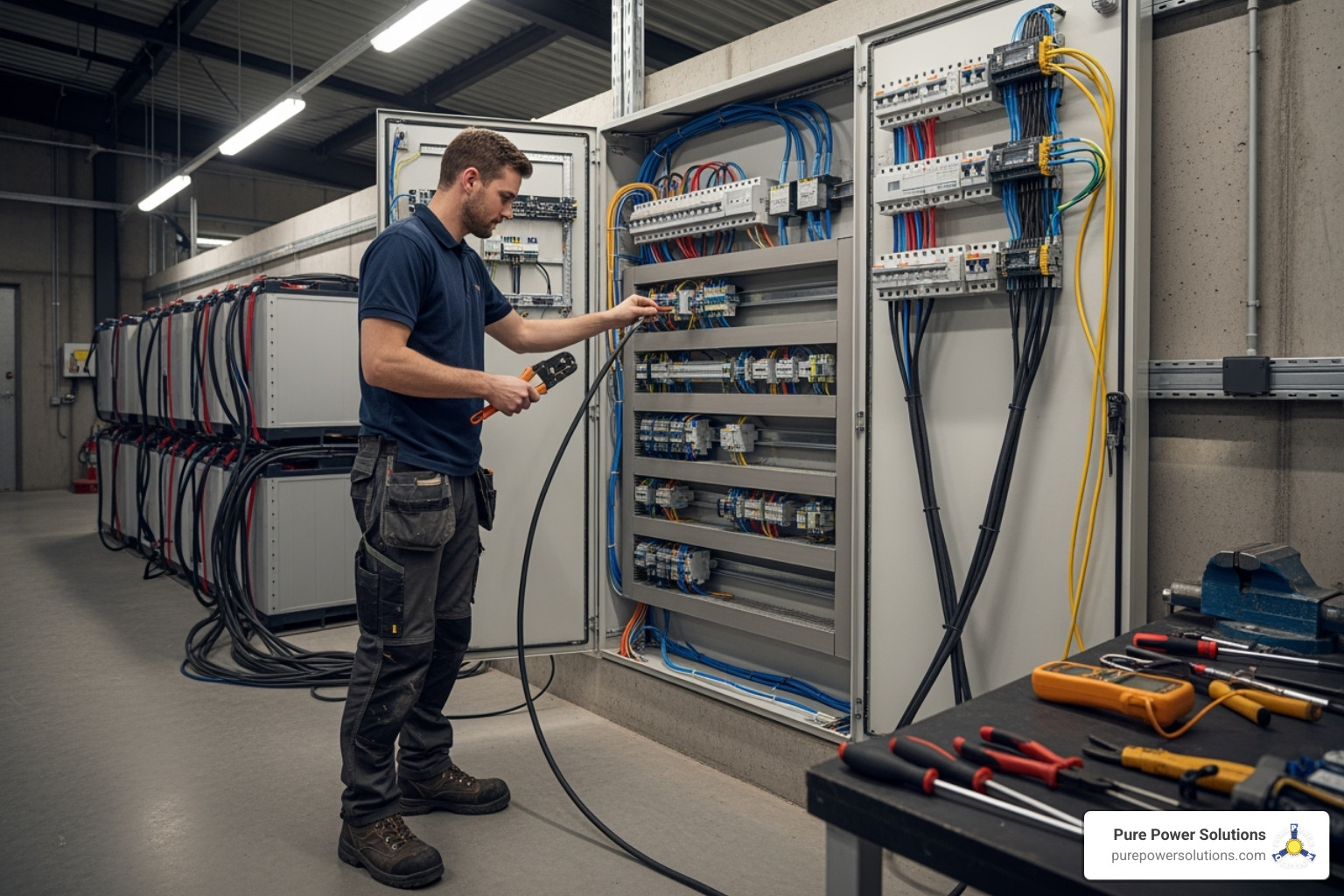
No two commercial facilities operate alike, so no two storage systems should be priced or designed alike. When Pure Power Solutions prepares a quote, we align technical choices with the value streams your organization cares about most—resilience, operational continuity, bill savings, or a combination of all three. Here are the biggest inputs to the final number you see on a proposal.
Battery chemistry, capacity, and power rating
- Lithium-ion (Li-ion): This chemistry, especially Lithium Iron Phosphate (LiFePO4), dominates commercial stationary storage. It offers high energy density, strong round-trip efficiency (often over 90%), and a long cycle life with excellent thermal stability, making it inherently safer than other lithium variants. While upfront costs are higher than legacy chemistries, the superior performance and longevity result in a significantly lower lifetime cost per delivered kWh.
- Lead-acid: This older technology remains less common in modern commercial applications due to lower cycle life, a shallower allowable depth of discharge (DoD), and more frequent maintenance needs. While the sticker price can be lower, the total cost of ownership is usually higher for businesses that cycle storage daily or require reliable long-duration backup.
- Usable capacity (kWh) versus power (kW): A BESS must be sized for both how much energy you need to store and how fast you need to discharge it. For example, riding through a 2-hour outage at a modest load requires sustained energy delivery (kWh-focused), while shaving short but steep 15-minute demand spikes requires high power output (kW-focused). The system’s power electronics and inverter selection are dictated by these goals.
A quick comparison to frame trade-offs:
- Li-ion: Higher upfront, lower lifetime cost; 10–15 years (often 4,000–6,000+ cycles); round-trip efficiency typically 90–95%; DoD commonly 80–100%; low maintenance; smaller physical footprint.
- Lead-acid: Lower upfront, higher lifetime cost if cycled frequently; 3–5 years (often 400–800 cycles); efficiency often 70–85%; DoD around 50%; requires regular maintenance (e.g., watering); larger footprint.
Right-sizing the system: Avoiding Wasted Capital
We work backward from your objectives to avoid both undersizing (which fails to meet goals) and oversizing (which wastes capital). An oversized battery has a poor return on investment, as the excess capacity is never used. An undersized one fails to provide the resilience or savings you paid for.
- Critical-loads backup: We help you identify the specific equipment that must stay on during outages—server rooms, refrigeration, security systems, lighting for safety and egress, communications, point-of-sale terminals, and HVAC for mission-critical areas. We then determine the target ride-through duration and model acceptable load-shedding scenarios.
- Demand charge reduction: We analyze your facility’s interval data to locate peak consumption windows, then size the system and configure controls to dispatch stored energy in those precise minutes (or hours) when demand charges are set.
- Time-shifting solar: We quantify your excess midday solar production and model how storing and dispatching that energy into high-value TOU periods improves bill outcomes under your current utility tariff.
Balance of system (BOS) and integration hardware
- Inverters and coupling: DC-coupled designs can improve conversion efficiency and savings in new-build solar-plus-storage scenarios, while AC-coupled systems are often more straightforward for retrofitting storage to existing solar arrays. Some batteries include integrated inverters; others require external inverters sized to your power needs.
- Critical-loads panel: Separating essential circuits into a dedicated sub-panel is a common and robust method for backup applications. Budget an additional $1,000 to $2,500 depending on the number of circuits and complexity.
- Electrical upgrades: Main service panel upgrades, new conductors, conduit, protective devices, and service disconnects are site-specific cost drivers that ensure safe, code-compliant operation for decades.
Controls, software, and metering
Intelligent controls make a measurable difference in commercial outcomes. The “brains” of the system are as important as the “brawn.” Accurate CT placement, real-time monitoring, and automated dispatch logic based on predictive algorithms ensure the battery engages at the right time and for the right duration. This intelligence can be as impactful as another few kWh of capacity when it comes to maximizing demand-charge reduction and TOU arbitrage.
Safety, code compliance, and permitting
Commercial installations must meet the latest codes and standards. Two widely referenced standards include:
- “Standard for the Installation of Stationary Energy Storage Systems” (NFPA 855). Reference: National Fire Protection Association, NFPA 855, https://www.nfpa.org/855.
- “Standard for Safety of Energy Storage Systems and Equipment” (UL 9540). Reference: UL Solutions, UL 9540, https://www.ul.com/resources/ul-9540.
Local permitting authorities may also require UL 9540A test data for thermal runaway performance, dedicated clearances, bollards for physical protection, gas detection, fire-resistance ratings, and specific signage. Designing for compliance from day one avoids rework, schedule delays, and surprise costs.
Installer expertise, commissioning, and lifecycle support
- Vetted installation: Commercial storage is an advanced electrical project. Using experienced, qualified electricians and project managers limits operational risk and improves long-term reliability.
- Commissioning and monitoring: Post-installation testing, software tuning, and operator training ensure the system behaves as modeled. Remote monitoring enables proactive service and performance verification.
- Warranty and O&M: Mainstream lithium-ion systems are commonly warrantied for 10–15 years or a fixed cycle count, guaranteeing a percentage of usable capacity (often 70%) at end of warranty. Modern systems are low-maintenance, but scheduled inspections and firmware updates help maintain peak performance. A solid warranty and an accessible service team are core to your total cost of ownership.
Reducing the Upfront Cost: Incentives and Financing

While the upfront number gets a lot of attention, smart financial planning can materially reduce the net cost of a commercial battery storage project. A combination of federal tax incentives and strategic financing can make even large-scale systems cash-flow positive from early on.
Federal Investment Tax Credit (ITC)
The most impactful incentive for many organizations is the federal ITC. This is a dollar-for-dollar reduction in your federal tax liability, not merely a deduction. Commercial solar projects will be eligible for the 30% tax credit through 2027, given the project meets certain parameters.
Accelerated Depreciation (MACRS)
Beyond the ITC, businesses can also benefit from accelerated depreciation. Under the Modified Accelerated Cost Recovery System (MACRS), the cost basis of the solar and storage equipment can be depreciated over a five-year schedule. This creates a significant additional tax shield, further improving the project’s overall return on investment. The combination of the 30% ITC and MACRS can reduce the net cost of a system by 50-60% for many tax-paying entities.
State and Utility Programs
In addition to federal incentives, some utilities and regional programs offer demand response, “Bring Your Own Battery,” or Virtual Power Plant (VPP) opportunities. These programs compensate businesses for allowing limited, pre-agreed dispatch events that help stabilize the local grid. These programs are highly specific and may open or close to new enrollments periodically, so it’s wise to evaluate them early in the planning timeline.
Financing strategies that keep ownership advantages
- Cash: The simplest path. It minimizes total lifetime cost and maximizes project IRR by avoiding all interest expenses.
- Commercial loans: Enable minimal upfront expenditure while allowing your business to retain full ownership and capture all tax benefits (ITC and depreciation). Total cost over time will be higher than cash, but cash flow can still be positive if monthly energy savings exceed the loan payments.
- Property Assessed Clean Energy (PACE): In participating jurisdictions, PACE financing can align repayment with property taxes and may offer appealing terms for energy improvements, as the loan is tied to the property rather than the business entity.
- Service agreements and leases: These structures shift the capital expense into an operating expense. While they typically involve a third party retaining ownership and the associated tax benefits, they can offer a zero-down path to resilience and savings. We help you weigh the trade-offs (ownership benefits, accounting treatment, and residual value) against your financial objectives.
As an example, a $30,000 cash project may cost substantially more over 15–20 years with zero-down financing, but it can also preserve working capital for core operations while delivering immediate resiliency and bill-management benefits. The “right” structure depends on your hurdle rate, tax appetite, and tolerance for operational risk.
Our team routinely researches and applies all relevant incentives for businesses in Sonoma, Napa, Mendocino, and Lake County, ensuring your proposal reflects the maximum available value at the time of contracting. If you’d like to discuss incentive timing, eligibility, and how these dollars affect optimal system size, we can model a few scenarios based on your latest 12 months of utility data.
Is a Solar Battery Worth the Investment? A Cost-Benefit Analysis
Deciding whether a commercial battery is worth the investment requires comparing upfront solar battery pricing with the quantifiable and strategic benefits your facility will realize over its lifetime. The strongest business cases typically combine avoided downtime, lower exposure to demand and time-of-use (TOU) charges, and better utilization of existing solar generation. A proper analysis goes beyond simple payback to consider metrics like Internal Rate of Return (IRR) and Net Present Value (NPV), which provide a more accurate picture of long-term financial performance.
Resilience and operational continuity
For many organizations, uptime is priceless. Consider a winery in Sonoma County during a Public Safety Power Shutoff (PSPS) event. If refrigeration and climate control for fermentation tanks fail, an entire vintage of product could be lost, representing tens or hundreds of thousands of dollars in revenue. If a dental office’s point-of-sale or patient management systems go down, revenue halts and appointments are lost. A correctly sized BESS keeps these critical circuits running, changing grid interruptions from operational crises into minor, manageable events. We help define which loads are “mission critical,” calculate the energy and power needed to ride through typical outage durations, and implement load shedding where appropriate to extend runtime.
Demand charge management and TOU arbitrage
- Demand charges: A brief, 15-minute surge in power draw from starting heavy equipment can set a costly monthly demand charge. For example, if your utility charges $25 per kW and your peak is 100 kW, that’s a $2,500 charge on your bill before you’ve even paid for the energy used. By discharging the battery to “shave” that peak by just 20 kW, a facility can save $500 on that month’s bill. Batteries excel at delivering these short, high-power bursts exactly when needed.
- Time-of-use rates: Storage can shift surplus midday solar energy—when it’s least valuable—into the late afternoon or evening peak-price periods, dramatically improving the value of every kWh your array generates. Even as rate structures evolve, a dispatchable asset gives you control and options.
Long-term electricity price exposure
Historically, commercial electricity rates trend upward over time, often unpredictably. A solar-plus-storage system lets you convert a portion of your variable electricity cost into a fixed capital investment with predictable performance. This acts as a powerful hedge against future utility rate volatility, making energy a more manageable and forecastable line item in multi-year budgets.
Lifespan, warranty, and degradation
Modern lithium-ion systems are commonly warrantied for 10–15 years or a set number of cycles, guaranteeing a specified percentage of usable capacity (often 70%) at the end of the term. This provides a bankable performance floor for financial modeling. Field experience shows that well-designed systems, when operated within recommended temperature and cycling ranges, can outperform these minimum warranty thresholds. The result is a predictable and reliable asset that continues delivering value long after installation.
Safety and compliance as business value
Commercial battery systems are engineered and installed under rigorous safety standards and local codes, incorporating thermal management, fault detection, automatic isolation, and clear signage for first responders. Properly implemented, these measures not only protect people and property but also reduce risk in insurance and compliance reviews, demonstrating a commitment to operational safety.
Environmental stewardship and corporate goals
For organizations with sustainability targets, storage increases the self-consumption of on-site solar, enabling deeper emissions reductions while supporting local grid stability. This provides a tangible, marketable story for customers, investors, and employees who value corporate social responsibility. As the U.S. Department of Energy has emphasized, energy storage “helps balance supply and demand, improves grid resilience, and enables more renewable energy on the system.” Source: U.S. DOE, Energy Storage, https://www.energy.gov/oe/activities/technology-development/grid-modernization-and-smart-grid/energy-storage.
When is storage most compelling?
- Your operation incurs significant financial or operational costs during even brief power outages.
- Demand charges represent a substantial portion (e.g., 30% or more) of your monthly electricity spend.
- You generate more solar energy during the day than you can use, and your utility offers low compensation for exports.
- You value predictable, controllable energy costs for long-term financial planning.
In all cases, the path forward is a data-driven feasibility review that quantifies potential benefits, aligns system design with your budget, and stages deployment to your operational calendar.
Conclusion: Your Next Steps Toward Energy Independence

Understanding solar battery pricing is the first step in building a resilient, cost-efficient energy strategy for your organization. As we’ve explored, the final price is a reflection of the value it delivers. A system’s true cost must be weighed against the financial losses from power outages, the persistent drain of high demand charges, and the opportunity cost of exporting valuable solar energy for pennies on the dollar. When designed around your specific objectives—be it resilience, demand management, or solar optimization—a commercial BESS can pay for itself multiple times over while safeguarding your critical operations.
The key takeaways are clear: look beyond the initial sticker price to the Total Cost of Ownership; ensure the system is carefully right-sized for your unique loads and goals; recognize that intelligent software is as crucial as the hardware; and leverage all available incentives like the ITC and accelerated depreciation to maximize your return on investment. A commercial battery is not a commodity purchase; it is a strategic capital investment in your business’s future.
For more than three decades, Pure Power Solutions has engineered, installed, and supported commercial solar and battery systems for organizations throughout Sonoma, Napa, Mendocino, and Lake County. Our focus is on practical, code-compliant designs that deliver measurable outcomes and long-term reliability. Whether you need targeted backup for critical loads, a sophisticated demand-charge reduction strategy, or a comprehensive solar-plus-storage microgrid, we’ll right-size a solution and stand behind it for its entire lifespan.
The first step is a data-driven feasibility review. We will analyze your utility bills and operational needs to provide a preliminary report on potential savings and resilience benefits. This no-obligation analysis ensures you have a clear picture of the ROI before making any commitments.
Contact Pure Power Solutions today for a free consultation. Visit our website at https://purepowersolutions.com or call us at 707-658-2157. Let’s evaluate your facility, model the savings and resilience benefits, and design a commercial battery system that fits your budget and business goals.


